

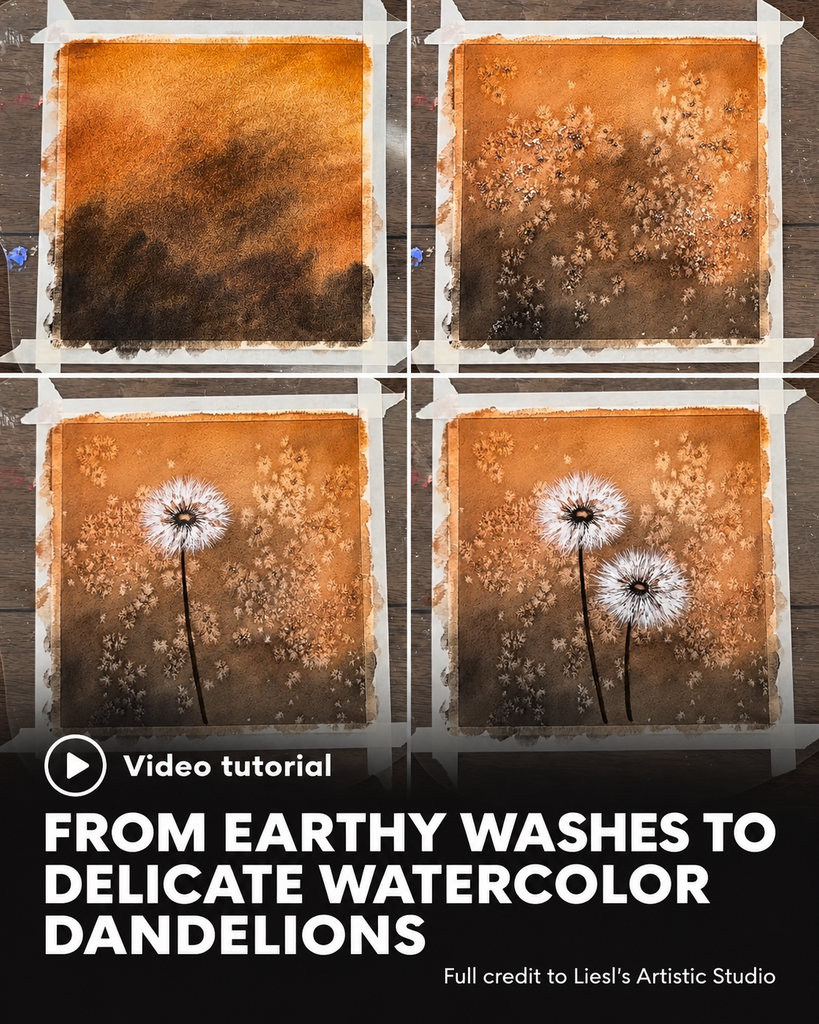
White dandelion seed heads stand out against an earthy background scattered with delicate salt patterns in this demonstration from Liesl’s Artistic Studio. The painting combines a freely blended watercolor wash with carefully layered white marks, creating depth without an elaborate preliminary drawing.
Its two main effects develop in different ways: sea salt shapes the wet background as it dries, while increasingly concentrated white paint builds the bright, fluffy flower heads. Together, they turn a simple arrangement of two dandelions into a richly textured piece.
A Simple Drawing Leaves Space for Texture
Liesl’s Artistic Studio begins with watercolor paper cut to 8 by 8 inches. The initial drawing is deliberately modest: two oval centers, a few lines radiating outward to suggest where the seeds will extend, and the stems below. The artist explains that even these guidelines are optional and that the subject can be painted freehand.
Choosing only two dandelions leaves room for the background to become a significant part of the painting. The salt texture is not planned as a minor finishing accent. It is one of the main features, so the composition gives it space around the seed heads and stems.
The artist initially draws the guidelines dark enough to be visible in the demonstration, then lightens them with a kneaded eraser. Later, the dark wash conceals those faint lines altogether. Rather than treating this as a problem that requires a new drawing, the artist places the dandelion centers by eye when the background is ready.
Why the Paper Goes on a Movable Support
Instead of taping the paper directly to the table, the artist attaches it to a separate plastic palette with artist tape. A movable board or another suitable support would serve the same purpose in the demonstrated approach. The tape helps manage the warping expected from the generous water and paint used in the background.
The separate support also serves two distinct purposes during painting. It can be lifted and tilted to encourage the wet colors to blend, and it can be rotated later to make the fine dandelion marks easier to reach. The setup supports both the loose wash and the more controlled detail work.
An Earthy Palette with an Opaque White Finish
The background colors are raw sienna, burnt umber, a dark mixture of burnt umber and ivory black, and ivory black on its own. The artist prepares each mixture with substantial pigment and enough water to remain fluid. This produces a progression from warm, lighter color to a deep brown and black foundation.
The artist presents these neutrals as a personal choice for the demonstration rather than a required palette for every version. Olive green joins the painting later in the stems, while opaque titanium white provides the pale lines and fluff that form the dandelion heads.
The tools begin with a number 10 round brush for the wash and a number 1 rigger for fine marks. A number 3 round is added later for the centers and stems. Clean water, a paper towel, sea salt, and the taped support complete the main working setup described in the tutorial.
White Paint and Masking Fluid Have Different Roles
The artist chooses opaque white watercolor so that pale marks can be painted over the dried background. Gouache is also offered as an alternative. The important quality for this demonstration is sufficient opacity to build visible layers over the dark wash.
Masking fluid is discussed as another possibility, but it is not used in the finished demonstration. The artist notes that it would need to be applied before the background. White paint is preferred here because successive layers can become brighter and more prominent, giving the seed heads the gradual buildup the artist wants.
A Wet Background Built from Light to Dark
The entire sheet receives an even layer of water before any color is added. The artist aims to avoid obvious pools and puddles, creating a wet surface across which the prepared paint can move. With the paper ready, the wash develops from the lighter colors toward the darker ones.
Raw sienna goes into the upper corners and partway down the sides. Burnt umber follows in the corners and around the areas intended for the dandelion heads. These darker surroundings are purposeful: the artist wants the later white details to stand out clearly against them.
The dark brown mixture strengthens the middle area and extends toward the bottom. Pure ivory black finishes the lower portion. The artist adjusts individual areas where more paint or smoother blending seems necessary, then lifts the support and tips it in different directions.
This movement allows the water and pigment to spread and merge more naturally. The wash does not need to describe every background shape with a brush. Its broader transitions establish the setting for the salt effect and the two flowers that will be painted afterward.
Sea Salt Creates the Background Pattern
Salt Goes onto the Wash While It Is Wet
Once the artist is satisfied with the background colors, sea salt is sprinkled onto the still-wet paper. This timing receives particular emphasis in the demonstration. The artist loosely concentrates some of the salt around the future dandelion heads without trying to control every individual mark.
The salt used is a Baja mineral sea salt that the artist had already tested in a practice painting. The artist suggests that other sea salts would probably work as well, while distinguishing the desired spreading texture from the different effect produced by table salt. This is presented as the artist’s experience and preference for this project, rather than a guarantee that every salt will behave identically.
As the background changes, the marks spread farther than the initial sprinkling might suggest. The artist’s intention is for the texture to resemble many little seeds floating through the background. That visual association connects the abstract pattern to the dandelion subject before any white seed heads have been painted.
Natural Drying Is Part of This Technique
Although the artist often uses a hair dryer in other demonstrations, this wash is left to dry naturally. The salt needs time to develop the texture, and the artist returns during the drying process to show the changing surface rather than speeding it up.
The tutorial gives no fixed drying time. Instead, the artist checks the painting’s condition. A surface that appears dry may still feel damp beneath some grains, so the salt is removed only after the paper has dried sufficiently. The artist rubs it away with fingers before moving on to the dandelions.
The resulting background carries much of the painting’s complexity. Its scattered, irregular texture provides a contrast to the more deliberate lines that will define the flowers, while the darker wash remains available to support the white details.
Dark Centers and Stems Establish the Dandelions
Using the number 3 round brush, the artist paints two oval centers with the dark brown already on the palette. A small opening is initially left in each center so a lighter area can show through. This is optional within the demonstration, and the artist later adjusts the highlight by lifting color.
The stems begin with dark brown near the heads, then transition into olive green farther down. This creates a change of color along their length instead of treating them as uniform dark lines. The upper portions stay closely connected to the dark centers above.
The number 1 rigger then adds fine brown lines around each center. These radiating marks represent the shadow portions of the seed head. They remain important even after the white paint arrives, because the artist does not intend the flower to become an uninterrupted patch of white.
A Lifted Highlight Reopens the Center
When some of the original light area becomes obscured, the artist moistens the center with a little water on a brush. A paper towel then dabs away water and loosened color, creating a lighter highlight inside the dark oval.
This small adjustment changes the center without repainting the entire flower head. It also demonstrates how the artist responds to the developing picture: an area that has become too dark can be revisited before the surrounding white layers are complete.
Layered White Marks Build the Fluffy Seed Heads
Fine Lines Preserve the Underlying Shadows
The first white marks are made with diluted opaque titanium white and the rigger brush. Thin lines extend around the center, placed among the dark lines rather than covering all of them. The artist explicitly aims to retain some of that earlier brown structure.
This alternation begins the relationship between light and shadow within the dandelion. The white gives brightness, while the darker marks remain visible between it. The effect depends on both colors continuing to play a role as the flower grows fuller.
Small Groups of Lines Become the Fluff
For the fluffy tips, the artist paints several short lines meeting at a shared point to suggest each little seed tuft. These clusters are repeated around the flower head. The first pass uses a more diluted white, establishing a circular arrangement without making every mark equally strong.
Additional clusters are placed closer to the center and farther outward. Their placement gradually shapes a larger, rounder head. The movable support can be turned as needed, allowing the artist to approach different sections of the circle without keeping the painting fixed in one orientation.
As the layers build, the white paint becomes thicker and more concentrated. Brighter marks appear toward the front, creating the layered effect emphasized throughout the tutorial. If too much of the dark center disappears, the artist restores a few brown lines so the shadows remain present.
The second dandelion is painted in the same way. The artist describes room for variation in the amount of fluff, including a fuller head, a sparser one, or a section left without it. The repeated marks provide a method, while their density and placement determine the final shape.
A Finished Painting with Space to Breathe
The earlier practice piece included a few separate seeds floating away from the flowers. The artist considers that addition but chooses not to repeat it in the demonstrated painting. It remains an optional variation rather than a feature of the final version.
The completed piece brings together an open-ended background process and a more deliberate approach to the foreground. Salt creates the scattered pattern as the wash dries, while dark lines and increasingly bright white layers give the dandelions their form. The sense of depth comes from those relationships: dark behind light, softer white beneath brighter marks, and fine flower details against a textured earthy wash.