

Unwind this holiday season with our collection of 28 cozy Christmas watercolor ideas designed to spark your holiday creativity. Whether you are an experienced artist looking for winter scene inspiration or a beginner seeking a relaxing creative outlet, these festive painting concepts offer something for everyone.
Plus, you can easily get started today with our downloadable, printable coloring pages that serve as the perfect outline for your watercolor practice!

28 Cozy Christmas Watercolor Ideas
Cozy Christmas stone cottage
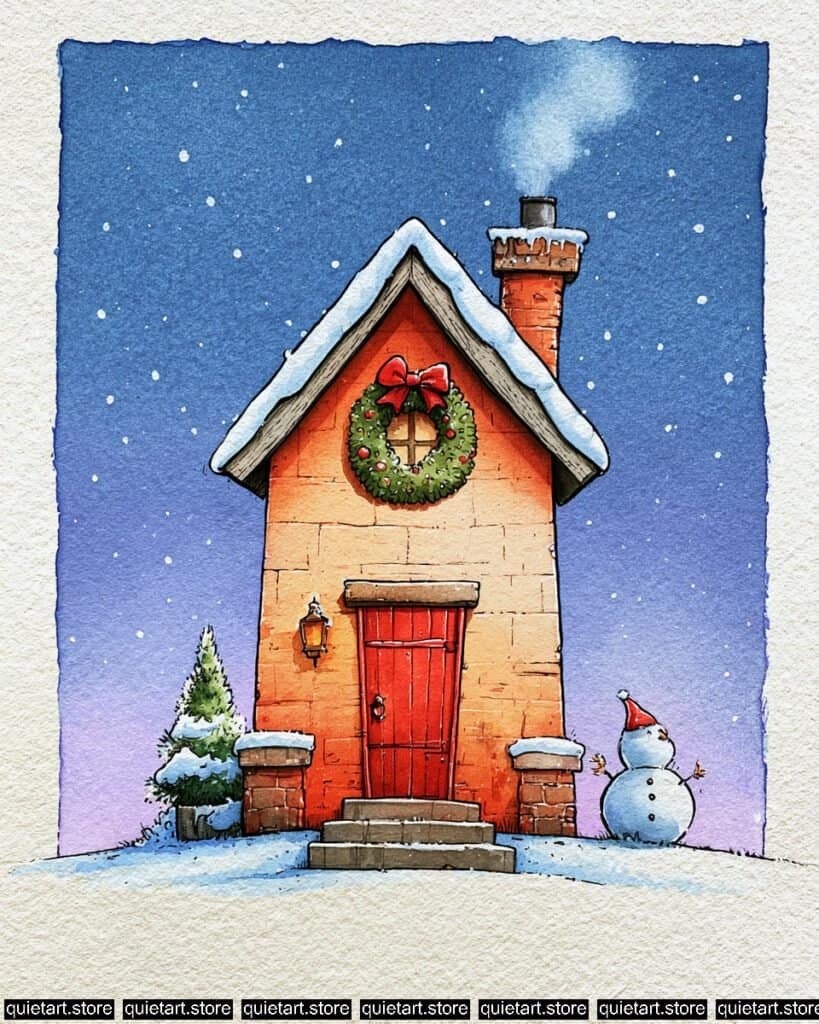
Begin by sketching the entire scene with a light pencil, defining the edges of the cottage, the snowman, the tree, and the decorative details like the wreath and snowman’s hat. Use a fine-liner waterproof pen to trace all the outlines and add the cross-hatching detail for texture on the brickwork, the roof shingle ends, and to suggest the dense foliage of the wreath and tree. For the background sky, apply a loose, graded wet-on-wet wash, letting the deep blue blend softly into the purple-lavender near the horizon, allowing the unpainted paper for the snowflakes and the smoke plume.
Use a wet-on-dry technique to paint the cottage, using warm peaches and ochres for the walls and a vibrant red for the door, ensuring the line work is fully dry first. For the wreath and tree, apply various greens with wet-on-dry layers to build density and shadow, adding final red pops for the bow and ornaments. Build contrast with darker glazes for shadows on the steps and the underside of the snowdrifts, and paint the subtle smoke curl. Once everything is complete and dry, you can add final, sharp snowflake details and bright white highlights with white gouache if desired.
Recommended Watercolor Pigments:
- Azo Yellow or New Gamboge (mixed into the peach wall washes and for the warm glow)
- Pyrrol Scarlet or Cadmium Red (for the door, the red bow, and ornaments)
- Sap Green (for the primary color of the wreath and tree)
- Hooker’s Green (mixed for deeper greens in the wreath and tree)
- Burnt Sienna (mixed into the reds for brickwork warmth and shading)
- Ultramarine Blue (for the background sky gradient and cool shadows)
- Ultramarine Violet (for the lower sky/horizon blend and shading on the snowman)
- Neutral Tint (diluted heavily for the smoke, and mixed for deep shadows)
Love these watercolor ideas? Get our 40 Christmas Watercolor Printable Coloring Pages (PDF Download) for even more fun, printable designs to paint this Christmas.
Dreamy young girl sitting on a window

Begin with a light pencil sketch to capture the girl, the small cat, and the window frame, then define the clean outlines using a fine waterproof ink pen. Apply a loose wet-on-wet wash for the background sky, blending deep teal-blue into soft indigo at the top while leaving a warm golden-orange glow near the bottom corner where the lantern rests.
Once the background is dry, focus on the warmth inside by painting a glowing gradient of bright yellow and warm peach across the girl’s profile, hands, and dress to capture the flickering lantern light. Glaze her hair and dress with rich violet, indigo, and deep brown tones using a wet-on-dry technique, carefully preserving the illuminated edges. Finally, paint the dark window pane frame and distant snowy pine silhouettes, finishing with flicked white gouache across the glass to create magical falling snowflakes.
Recommended Watercolor Pigments:
- New Gamboge or Cadmium Yellow (for the intense warm glow of the lantern flame and light spill)
- Cadmium Orange or Pyrrol Scarlet (for the warm glow on the girl’s face, hands, and ear)
- Phthalo Blue or Cobalt Turquoise (for the vibrant cool blue background and snowy pine tree silhouettes)
- Dioxazine Violet or Ultramarine Violet (for the soft purple shadows on her dress and the top highlight of her hair)
- Indigo or Payne’s Gray (for the deep shadows in her hair, the dark window frame, and nighttime contrast)
- Burnt Umber or Sepia (for the cat’s fur and warm ground shadow tones)
- Permanent White Gouache (for splattering delicate falling snowflakes across the scene)
Love these watercolor ideas? Get our 40 Christmas Watercolor Printable Coloring Pages (PDF Download) for even more fun, printable designs to paint this Christmas.
Happy snowman

Begin with a light pencil sketch to outline the happy snowman, his cozy knitted hat, scarf, twig arms, and the circular snow angel patterns around him. Apply a very soft, wet-on-wet wash of cool blue across the snow ground, then use a wet-on-dry technique with a round brush to paint the sweeping, curved arches around the snowman and the dotted footprint trails with a more saturated cool gray-blue tone.
Once the snowy background washes are dry, paint the vibrant knitted hat with warm orange and terracotta shades, layering darker ridges for the ribbed knit texture and pom-pom fluff. Finish by filling in the scarf with a warm mustard yellow wash, carefully detailing the facial features and delicate twig arms using a fine waterproof ink pen or dark brown paint, and adding subtle shadows beneath the hat and scarf for form.
Recommended Watercolor Pigments:
- Cerulean Blue or Cobalt Blue (diluted heavily for the soft blue snow base and cool shadows)
- Payne’s Gray or Ultramarine Blue (mixed with blue for the darker snow angel swoops and footprint trail marks)
- Cadmium Orange or Pyrrol Orange (for the vibrant knitted hat)
- Burnt Sienna or Terra Cotta (for the deep shadows and ribbed texture on the hat)
- Yellow Ochre or Raw Sienna (for the warm yellow knitted scarf)
- Burnt Umber or Sepia (for the twig arms, smile, and eyes)
Love these watercolor ideas? Get our 40 Christmas Watercolor Printable Coloring Pages (PDF Download) for even more fun, printable designs to paint this Christmas.
Happy snowman with carrot nose
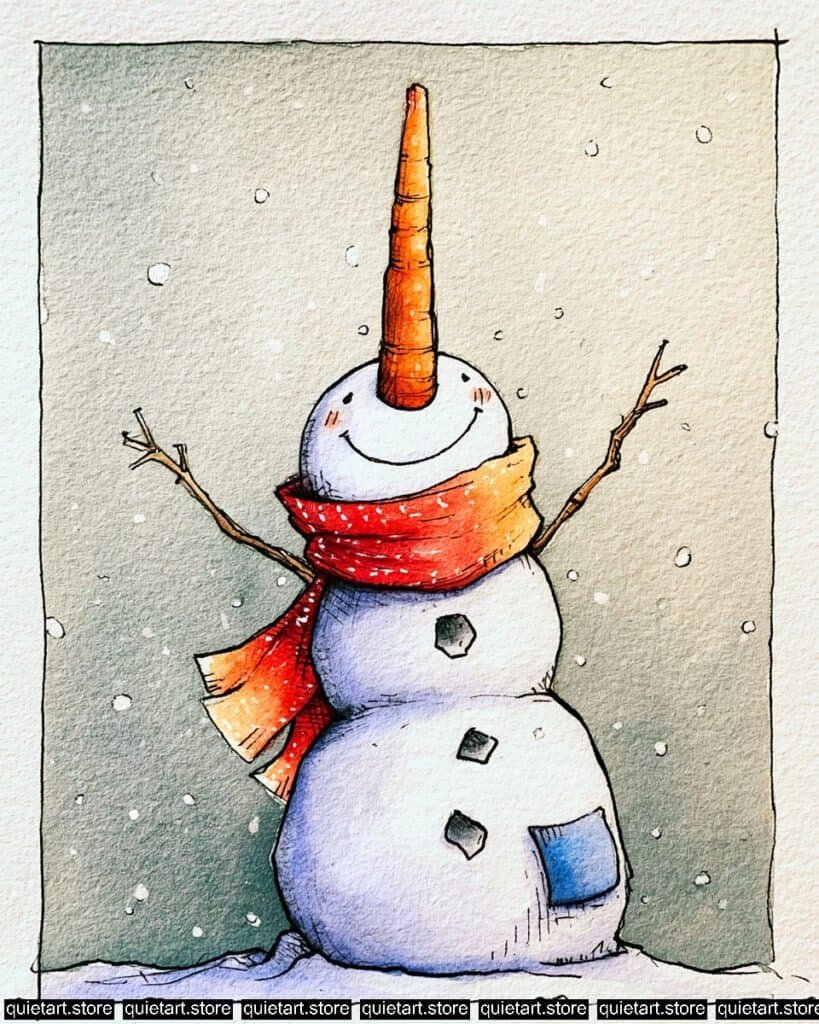
Begin with a light pencil sketch to capture the snowman, the extra-tall carrot nose, the scarf, twig arms, and the lower door, then trace all main contours using a fine waterproof ink pen for clean illustrative lines. Apply loose, muted wet-on-wet background washes, softly blending faded peach near the right top into a deep gray-teal along the left and bottom edges, while leaving small, clean water circles for the falling snow.
Once the initial background wash is dry, use a precise wet-on-dry technique with saturated pigments to paint the warm orange carrot nose and the bright red-orange scarf, carefully detailing the scarf’s white pattern by either dabbing white gouache or preserving the white paper. Finish by painting the small lower door with cobalt blue, using diluted purple-blue glazes for soft shadows on the snowy body, and re-accentuating facial features and cross-hatching texture on the carrot and bottom with the ink pen.
Recommended Watercolor Pigments:
- Permanent Rose or Alizarin Crimson (blended with yellow for the bright red-orange scarf base)
- Permanent Yellow Deep or New Gamboge (blended with red for the scarf gradient and used for the bright carrot nose base)
- Burnt Sienna (mixed into the orange for deeper shadow tones on the carrot nose and stick arms)
- Cobalt Blue (for the small door color and diluted heavily for cool shadows on the snow body)
- Dioxazine Violet or Ultramarine Violet (heavily diluted for the soft purple shadows on the fluffy snow body sections)
- Payne’s Gray or Neutral Tint (mixed with blue for the deep teal-gray background tones and lower edge)
- Potter’s Pink (diluted heavily for the subtle rosy cheek blush)
- Permanent White Gouache (optional, for touch-ups or extra sharp snowflake details)
Love these watercolor ideas? Get our 40 Christmas Watercolor Printable Coloring Pages (PDF Download) for even more fun, printable designs to paint this Christmas.
Ice house

Begin by lightly sketching the dome structure, arched entryway, wooden door, and crooked chimney, then trace the outlines and block-like textures with a fine waterproof ink pen. Apply a loose, soft wet-on-wet background wash using a warm, pale yellow or cream tint behind the igloo, leaving plenty of unpainted paper around the edges.
Once the initial background is dry, paint each ice block individually using a wet-on-dry technique, softly tinting them with pastel washes of dusty rose, sage green, and muted teal to capture the varied stone-like tones. Finish by painting the vibrant red wooden door, layering warm brown tones on the bent metal chimney, and using a cool blue-gray glaze to cast soft shadows under the snowy ledges and along the base of the structure.
Recommended Watercolor Pigments:
- Yellow Ochre or Raw Sienna (diluted heavily for the warm background halo wash)
- Cobalt Teal or Phthalo Green (diluted for the pastel teal and sage green ice blocks)
- Potter’s Pink or Venetian Red (diluted for the dusty rose and peach ice blocks)
- Pyrrol Red or Alizarin Crimson (for the vibrant red wooden door)
- Burnt Umber or Sepia (for the stovepipe chimney and door accents)
- Cerulean Blue or Cobalt Blue (heavily diluted for the cool shadows under the snow caps and base)
Love these watercolor ideas? Get our 40 Christmas Watercolor Printable Coloring Pages (PDF Download) for even more fun, printable designs to paint this Christmas.
Red scarf sheep
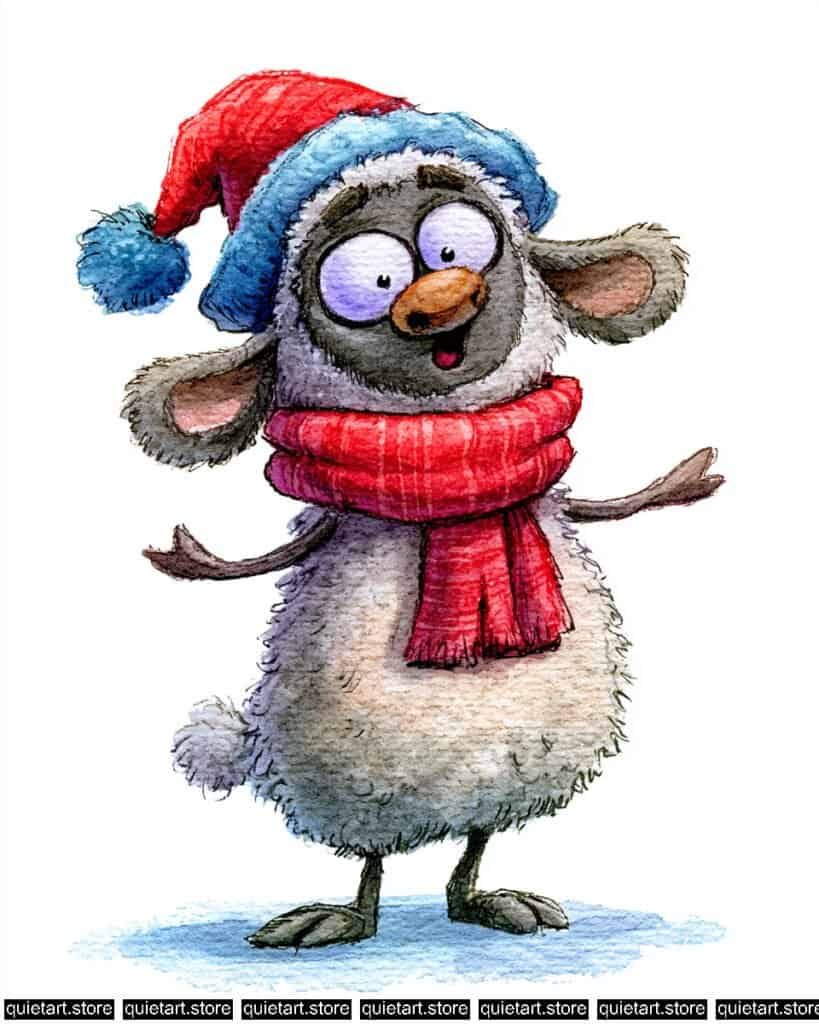
Start with a light pencil sketch to capture the silly posture, wide eyes, and cozy winter accessories of the sheep, then reinforce the contours and fur texture using a fine waterproof ink pen. Apply initial soft, transparent washes of warm cream and light gray across the woolly fleece, preserving the center brightness while adding a delicate lavender-violet wash around the eyes and under the chin.
Once the base layer dries completely, use a precise wet-on-dry technique to lay down rich glazes of vibrant red on the hat and scarf, alongside bright cerulean blue for the pom-pom and hat brim. Finish by layering dark charcoal tones onto the face, ears, and slender legs, softly blending a cool blue cast shadow beneath the hooves, and using fine pen work or opaque white highlights to define the knitted scarf texture.
Recommended Watercolor Pigments:
- Pyrrol Red or Cadmium Red Medium (for the vibrant winter hat and ribbed scarf)
- Cerulean Blue or Cobalt Blue (for the fluffy blue pom-pom, hat brim, and snow ground shadow)
- Burnt Sienna & Raw Sienna (for the warm tan nose, inner ear blush, and cream fleece shading)
- Payne’s Gray or Neutral Tint (for the dark charcoal-gray face, ears, and hooves)
- Dioxazine Violet (heavily diluted for the subtle purple shadow around the eyes and wool folds)
- Permanent White Gouache (optional, for crisp eye catchlights and knitted fabric highlights)
Love these watercolor ideas? Get our 40 Christmas Watercolor Printable Coloring Pages (PDF Download) for even more fun, printable designs to paint this Christmas.
Silly polar bear

Begin with a gentle pencil sketch outlining the polar bear, its red scarf, and the snowy ledge, followed by refining the contours with a fine waterproof ink pen for a crisp illustrative look. Apply a soft wet-on-wet gradient across the framed background, transitioning smoothly from a deep teal-green at the top to a pale mint shade near the bottom, taking care to preserve unpainted paper for the snowflakes and outer border.
Once the background is dry, lay down a warm cream and light tan wash over the polar bear’s body, leaving the upper head lighter and adding a subtle rosy blush to the cheek. Finish by painting the scarf with a bold red-orange glaze, tinting the ice ledge with a cool blue-grey wash, and adding a dark black accent for the nose while flicking white gouache for extra snowy highlights.
Recommended Watercolor Pigments:
- Cobalt Teal & Phthalo Green (blended for the rich teal-to-mint background gradient)
- Cadmium Red Medium or Pyrrol Orange (for the vibrant red scarf)
- Raw Sienna or Yellow Ochre (diluted heavily for the warm cream fur and body shading)
- Cerulean Blue or Cobalt Blue (diluted for the icy ledge wash)
- Potter’s Pink (diluted for the soft cheek blush)
- Lamp Black or Payne’s Gray (for the dark snout and nose shadow)
- Permanent White Gouache (for crisp snowflake splatters)
Love these watercolor ideas? Get our 40 Christmas Watercolor Printable Coloring Pages (PDF Download) for even more fun, printable designs to paint this Christmas.
Small red coat traveler
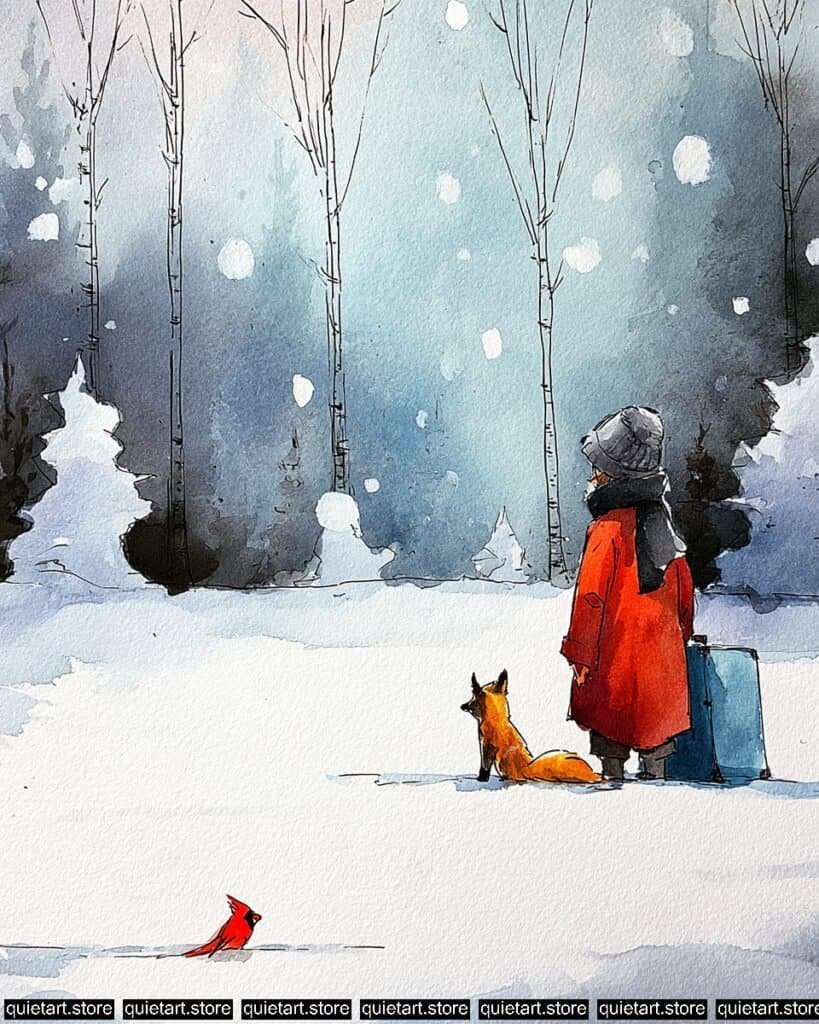
Start with a soft pencil sketch to outline the figures, bare trees, and snowy ground, then refine key outlines and tree details using a fine waterproof ink pen. Apply a loose, dramatic wet-on-wet wash for the forest background, blending atmospheric slate blues and cool grays while dropping in water droplets or lifting color to create soft, out-of-focus bokeh snowflakes.
Once the background wash is dry, use a wet-on-dry technique to paint the traveler’s bold red coat, the bright orange fox, and the tiny cardinal, ensuring these focal points pop against the snowy landscape. Finish by detailing the traveler’s gray beanie, scarf, and blue suitcase, layering pale lavender-blue washes across the foreground snow for shadows, and adding sharp white gouache dots for falling snow.
Recommended Watercolor Pigments:
- Pyrrol Red or Cadmium Red Medium (for the traveler’s red coat and the cardinal)
- Cadmium Orange or Burnt Sienna (for the little fox’s fur)
- Indigo & Payne’s Gray (for the moody winter forest background and dark trees)
- Ultramarine Blue or Cobalt Blue (for the suitcase and cool shadows on the snow)
- Neutral Tint or Lamp Black (for the beanie, scarf, boots, and line accents)
- Permanent White Gouache (for crisp, opaque snowflakes)
Love these watercolor ideas? Get our 40 Christmas Watercolor Printable Coloring Pages (PDF Download) for even more fun, printable designs to paint this Christmas.
Snowman portrait
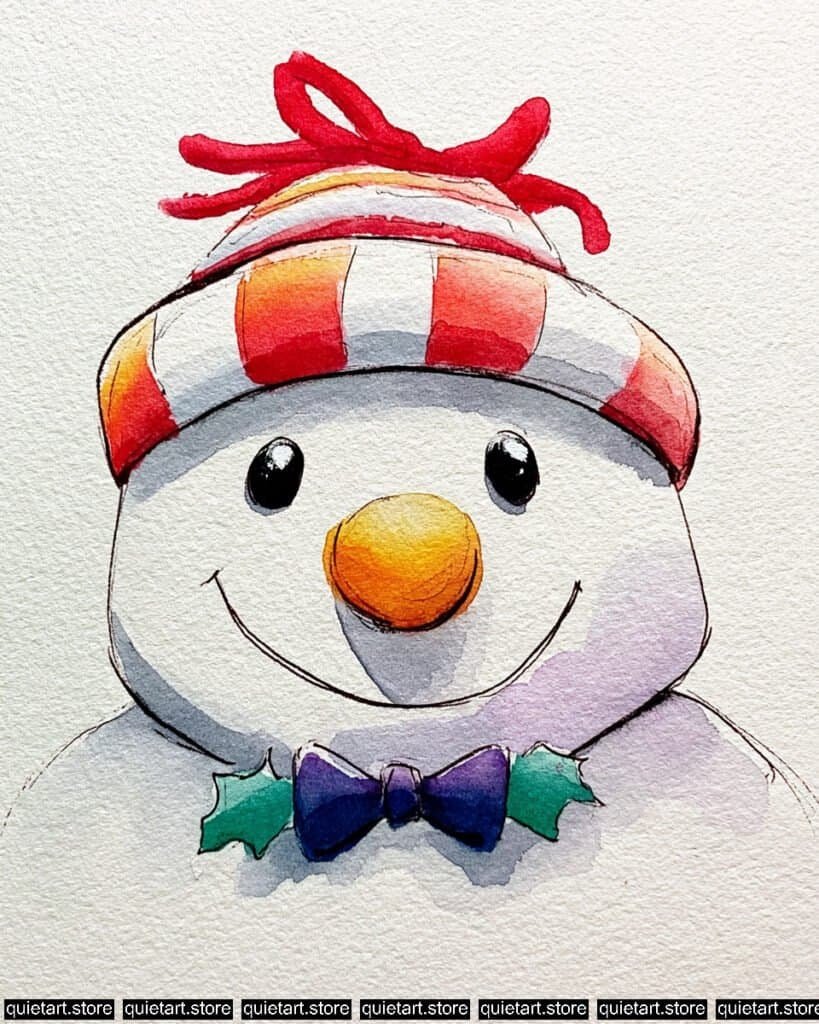
Begin with a light pencil sketch to capture the snowman’s round face, button eyes, carrot nose, beanie, and bow tie, then define the major contours using a fine waterproof ink pen. Apply a very pale, wet-on-wet wash of cool gray-blue and soft lavender across the left and lower sides of the snowman’s face to establish subtle dimensional shading, leaving the main front area pristine white paper.
Once the initial shadow wash is dry, use a precise wet-on-dry technique to paint the vibrant striped beanie and top bow with warm orange-red glazes, blending in yellow highlights on the carrot nose. Complete the illustration by painting the bow tie in deep violet-blue alongside bright green holly leaves, then fill in the eyes with opaque black pigment while preserving the tiny white highlights.
Recommended Watercolor Pigments:
- Pyrrol Red or Cadmium Red Medium (for the striped beanie and red tassel bow)
- Cadmium Yellow & Cadmium Orange (for the glowing carrot nose and orange beanie stripes)
- Dioxazine Violet & Ultramarine Blue (for the deep purple bow tie and heavily diluted for cool face shadows)
- Hooker’s Green or Viridian (for the green holly leaves behind the bow tie)
- Payne’s Gray or Lamp Black (for the dark eyes and smile line accents)
- Permanent White Gouache (optional, for touch-up highlights in the eyes)
Love these watercolor ideas? Get our 40 Christmas Watercolor Printable Coloring Pages (PDF Download) for even more fun, printable designs to paint this Christmas.
Tiny Santa Claus in snow forest
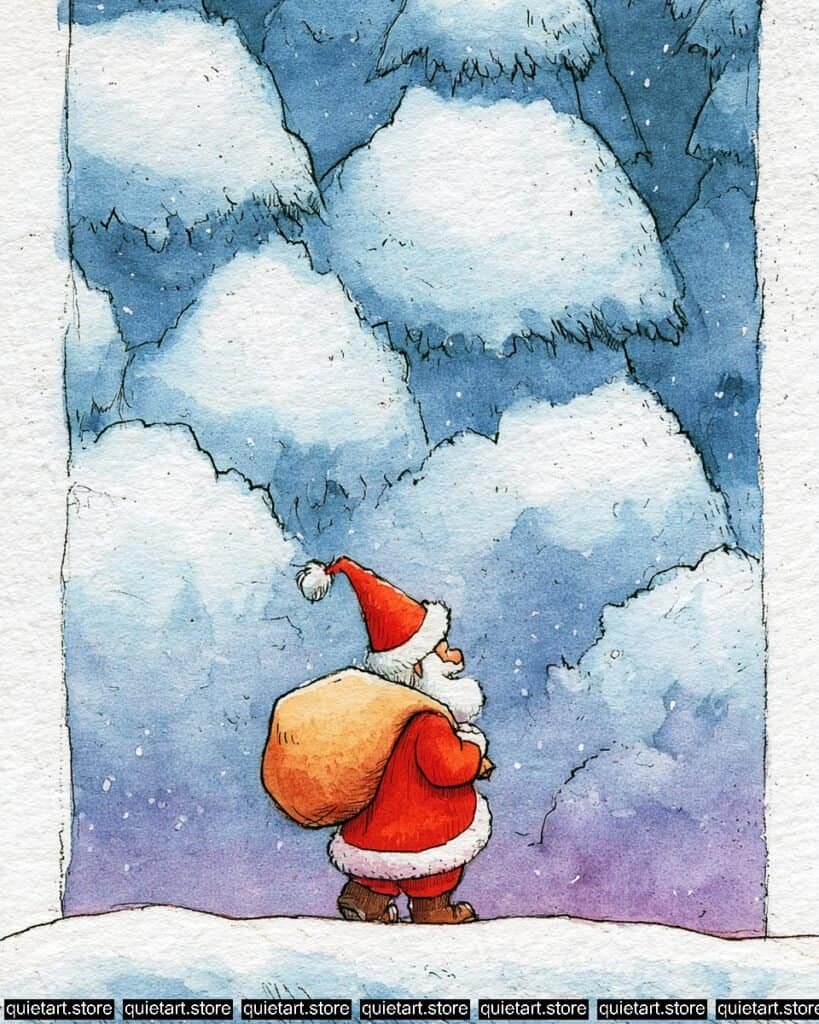
Begin with a soft pencil sketch to outline tiny Santa, his toy sack, and the large snow-laden pine trees, then trace all main contours using a fine waterproof ink pen for clean illustrative linework. Apply a wet-on-wet wash for the atmospheric forest background within the border, blending soft violet at the bottom near the horizon into deep blue-gray at the top while reserving the bright white paper for the snow-covered tree mounds.
Once the initial background is dry, focus on the foreground subject using a wet-on-dry technique, painting Santa’s coat and hat with a vibrant red glaze and his sack with warm golden ochre. Finish by layering diluted blue-violet shadows along the bases and undersides of the snowy branches, adding line texture to the boots and coat, and flicking white gouache across the scene for falling snowfall.
Recommended Watercolor Pigments:
- Pyrrol Red or Cadmium Red Medium (for Santa’s iconic coat and hat)
- Yellow Ochre or Raw Sienna (for Santa’s warm gift sack)
- Indigo & Payne’s Gray (for the dark blue-gray background trees and deep forest shadows)
- Dioxazine Violet or Ultramarine Violet (diluted heavily for the soft purple wash at the base of the forest)
- Cobalt Blue or Cerulean Blue (diluted for the cool shadows on the snow drifts and hat trim)
- Burnt Umber (for Santa’s boots and subtle line shading)
- Permanent White Gouache (for the opaque falling snowflakes)
Love these watercolor ideas? Get our 40 Christmas Watercolor Printable Coloring Pages (PDF Download) for even more fun, printable designs to paint this Christmas.
Thatched cottage Christmas door

Begin by sketching the entire scene with a light pencil, defining the cottage, the thatched roof, the brick chimney, the windows, and the snowman. Use a fine-liner waterproof pen to trace all the outlines and add the cross-hatching detail for texture on the thatch, brickwork, and snowman’s hat. For the background sky, apply a loose, graded wet-on-wet wash, letting the deep blue blend softly into the purple-lavender near the horizon, allowing the unpainted paper for the snowflakes and the smoke plume.
Use a wet-on-dry technique to paint the cottage, using warm peaches and ochres for the walls and a vibrant red for the door, ensuring the line work is fully dry first. For the wreath, apply various greens with wet-on-dry layers to build density and shadow, adding final red pops for the bow and ornaments. Build contrast with darker glazes for shadows on the steps and the underside of the snowdrifts, and paint the subtle smoke curl rising from the chimney. Once everything is complete and dry, you can add final, sharp snowflake details and bright white highlights with white gouache if desired.
Specific Watercolor Pigment Recommendations:
- Ultramarine Blue (heavily diluted for the lower sky and window shadows, and mixed into shadows)
- Payne’s Gray (mixed into shadows and used diluted for the smoke and window panes)
- Quinacridone Rose or Opera Rose (diluted heavily for the pink sky blend and the snowman’s cheeks)
- Azo Yellow or New Gamboge (mixed into the peach wall washes and the warm foreground glow)
- Cadmium Red Medium or Pyrrol Red (for the door, the red bow, and ornaments)
- Burnt Sienna (mixed into the reds for brickwork warmth and shading)
- Sap Green (for the primary color of the wreath and bushes)
- Hooker’s Green (mixed for deeper greens in the wreath and bushes)
- Permanent White Gouache (optional, for touch-ups or crisp snowflake details)
Love these watercolor ideas? Get our 40 Christmas Watercolor Printable Coloring Pages (PDF Download) for even more fun, printable designs to paint this Christmas.
A festive wreath and a bright red ribbon
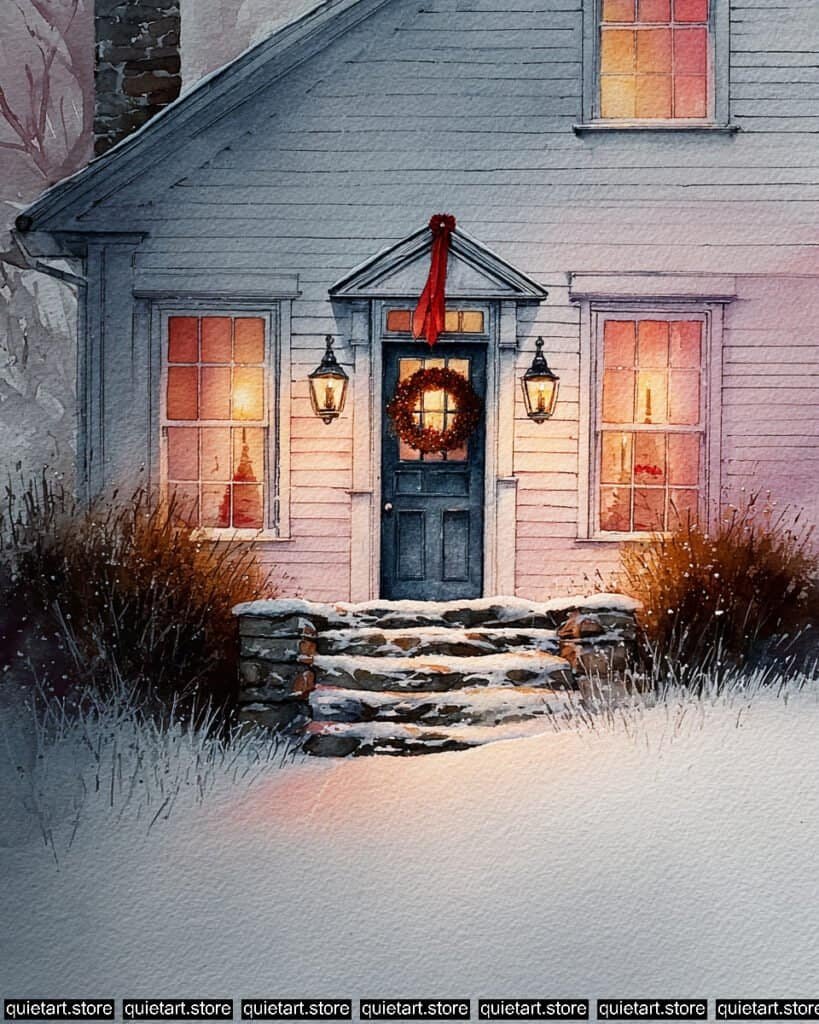
Start with a light pencil sketch of the house structure, focusing on the central door, windows, and stone steps to establish clean, precise proportions. Apply a soft wet-on-wet wash across the snow and siding using warm peaches, gentle pinks, and cool violet-blues to capture the inviting glow spilling from the interior lights onto the winter landscape.
Once the initial washes are completely dry, use a precise wet-on-dry technique to paint the fine details of the siding, window frames, dark wooden door, and lanterns. Finish by building deep contrast with dark earth tones in the stone steps and foliage, adding vibrant pops of red to the wreath and ribbon, and flicking white gouache across the foreground to create atmospheric snow highlights.
Recommended Watercolor Pigments:
- Cadmium Red Light or Pyrrol Red (for the vibrant ribbon, wreath accents, and warm window tones)
- Gamboge or New Gamboge (for the glowing interior candlelight)
- Cobalt Blue or Ultramarine Blue (for cool shadows on the snow and siding)
- Quinacridone Rose or Opera Rose (for the subtle pinkish hues reflected on the house walls)
- Payne’s Gray or Indigo (for the dark front door, lantern details, and deep shadow accents)
- Burnt Sienna & Raw Umber (for the stone steps, dried bushes, and pine wreath base)
Love these watercolor ideas? Get our 40 Christmas Watercolor Printable Coloring Pages (PDF Download) for even more fun, printable designs to paint this Christmas.
A friendly snowman

Begin with a clean pencil sketch outlining the snowman, the little mouse, and the glowing star wand, followed by defining the main contours with fine waterproof ink. Next, lay down a soft wet-on-wet wash for the magical background glow, blending bright yellow into warm orange, teal, deep ultramarine blue, and rich purple around the edges.
Once the background is dry, apply soft glazes to color the figures, using cool shadows on the snowman’s body to reflect the glowing light and warm reds for the hat, scarf, and little cape. Complete the illustration by re-emphasizing line details where needed and splattering white gouache or opaque white ink across the scene to create starry, falling snow textures.
Recommended Watercolor Pigments:
- Hans Yellow Medium or Lemon Yellow (for the glowing star halo and warm highlights)
- Cadmium Red Medium or Pyrrol Red (for the snowman’s hat, scarf, mittens, and the mouse’s cape)
- Cobalt Blue & Dioxazine Violet (for the deep night sky gradient and cool soft shadows on the snow)
- Phthalo Turquoise or Cobalt Teal (for the mid-tone transition in the background glow)
- Raw Sienna or Burnt Sienna (for the mouse’s fur and the carrot nose)
- Permanent White Gouache (for splattering snowfall and bright starlight dots)
Love these watercolor ideas? Get our 40 Christmas Watercolor Printable Coloring Pages (PDF Download) for even more fun, printable designs to paint this Christmas.
A quaint red-brick cottage
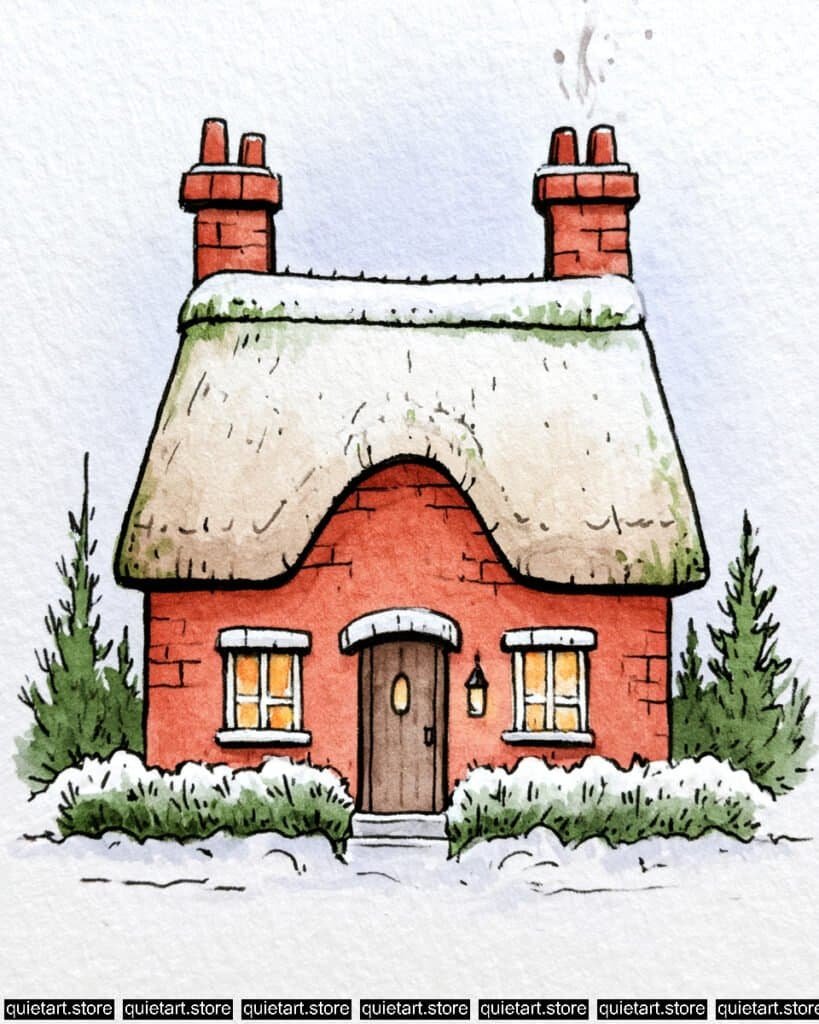
Start with a precise pencil sketch of the cottage and surrounding elements, then refine the major lines with a waterproof ink pen to establish the charming illustration style. Begin painting with initial wet-on-wet washes: a soft, muted sky, warm terra cotta for the walls and chimneys, and pale yellow inside the windows, allowing these areas to dry completely. Next, apply soft, light-valued earth and sap green tones to the thatched roof and ground shrubs, leaving the snowy patches untouched.
Once the base washes are dry, use a focused wet-on-dry technique to build depth by layering richer greens and earth tones in the trees, door, and shadows. For a festive finish, re-ink any outlines or details with small, controlled strokes, and add final, clean white highlights (or gouache) on the roof snow and step for a clean, wintery feel.
Recommended Watercolor Pigments:
- Burnt Sienna (for the main brick walls and chimneys)
- Sap Green & Hooker’s Green (for the trees and shrubs)
- Yellow Ochre or Raw Sienna (for the warm window glow and roof base)
- Burnt Umber or Sepia (for the front door and deep shadows)
- Cobalt Blue (diluted for the sky and snowy shadows)
- Permanent White Gouache (for clean snowy roof tops and details)
Love these watercolor ideas? Get our 40 Christmas Watercolor Printable Coloring Pages (PDF Download) for even more fun, printable designs to paint this Christmas.
A small black cat
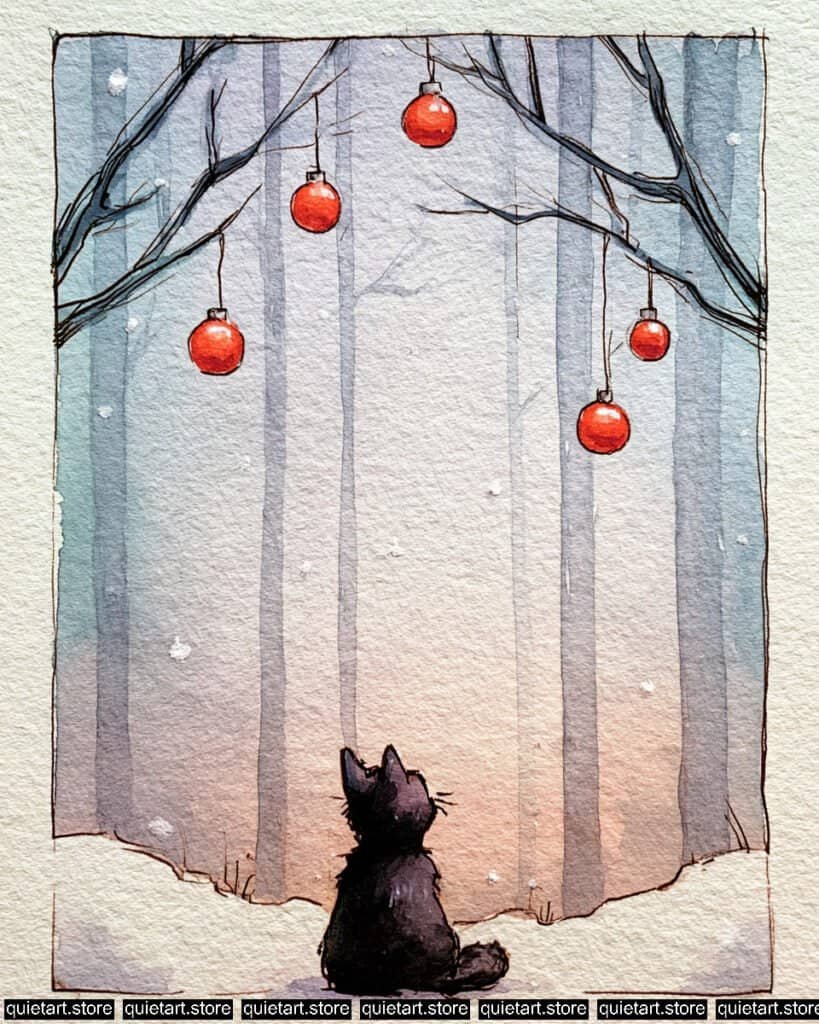
Begin by establishing the composition with a light pencil sketch, followed by mapping out the faint trees and the ground line using a fine-tipped, waterproof ink pen to maintain a clean illustration aesthetic. For the atmospheric background, apply soft wet-on-wet washes of muted peach and soft violet, allowing them to blend subtly to create a gentle, diffuse light source between the trees. Lay down initial light-valued gray and cool blue glazes on the dominant vertical tree trunks.
Once the background is completely dry, focus on building depth by layering darker cool grays onto the prominent branches and the body of the black cat. For the festive elements, paint the hanging ornaments using rich, saturated red pigments, carefully leaving a tiny unpainted highlight on each for realistic shine. Finally, use a dry brush technique to re-establish fine details on the cat and tree bark, then flick or paint small dots of opaque white gouache to simulate falling snowflakes.
Recommended Watercolor Pigments:
- Burnt Sienna & Alizarin Crimson (blended to create the warm, diffused peach glow)
- Cobalt Blue & Dioxazine Violet (diluted for the soft atmospheric background and cool tree shadows)
- Cadmium Red Medium or Pyrrol Red (for the vibrant Christmas ornaments)
- Ultramarine Blue & Burnt Umber (blended to create various cool and neutral grays for the trees)
- Lamp Black or Ivory Black (for the black cat)
- Permanent White Gouache (for the opaque white snowflakes)
Love these watercolor ideas? Get our 40 Christmas Watercolor Printable Coloring Pages (PDF Download) for even more fun, printable designs to paint this Christmas.
A cheerful Santa Claus

Start with a light pencil sketch to establish the proportions of Santa and the brick chimney, followed by outlining the details with fine, waterproof ink and cross-hatching for shading. Apply a loose, expressive wet-on-wet wash in muted dusty pink behind Santa, allowing natural watercolor blooms and splatter marks to create a rustic, painterly background backdrop.
Once the initial background area is dry, lay down initial transparent washes of vibrant red for Santa’s suit, hat, rosy cheeks, and the brick facade, while leaving the fur trim and beard mostly unpainted paper. To finish, use a wet-on-dry technique to add depth with darker red-brown glazes on the bricks, paint cool grayish-blue shadows on the chimney cap and fur trim, and re-accentuate the linework where needed.
Recommended Watercolor Pigments:
- Cadmium Red Medium or Pyrrol Red (for Santa’s iconic coat, hat, and bright red cheeks)
- Potter’s Pink or Venetian Red (diluted for the muted, textured backdrop splash)
- Burnt Sienna (mixed into the reds for warm brick tones and subtle shading)
- Payne’s Gray or Cerulean Blue (diluted for soft shadows on the white fur trim, beard, and chimney cap)
- Titanium White or Permanent White Gouache (optional, for touch-ups or tiny highlights)
Love these watercolor ideas? Get our 40 Christmas Watercolor Printable Coloring Pages (PDF Download) for even more fun, printable designs to paint this Christmas.
A fluffy white sheep Christmas
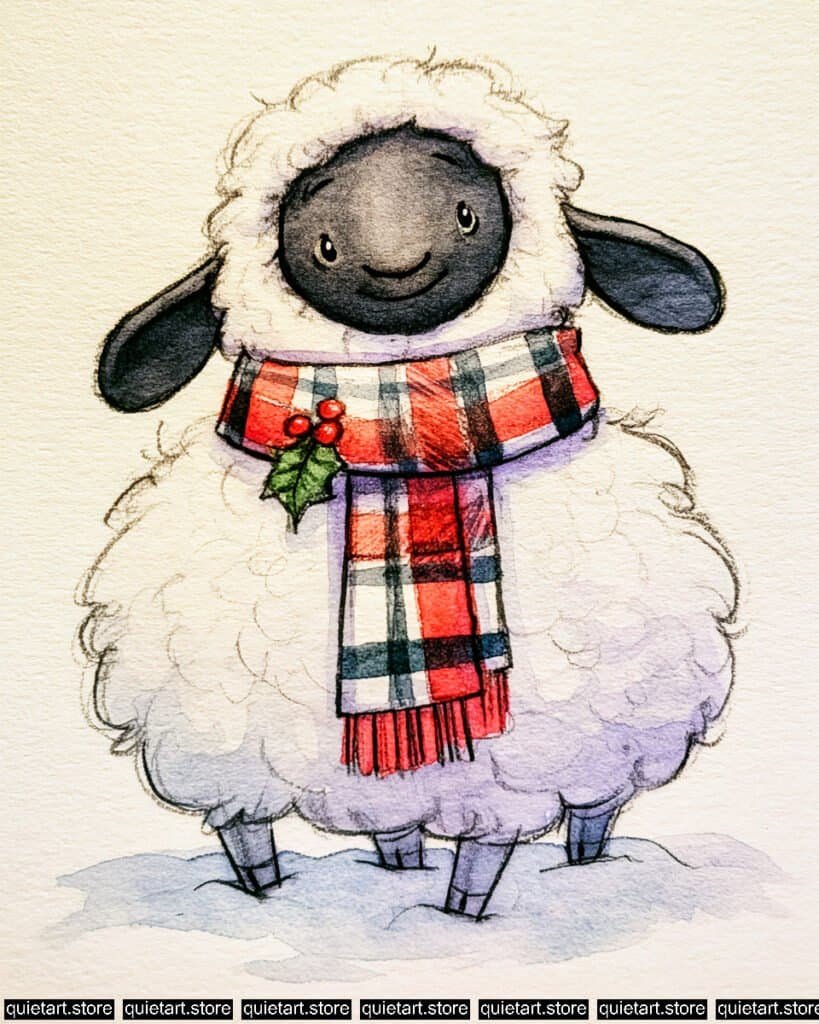
Start with a soft pencil sketch to outline the sheep’s fluffy body, plaid scarf, and dark face, then refine the details with a fine-tipped waterproof ink pen to create the expressive linework. Apply a delicate wet-on-wet wash of cool violet and soft gray along the lower edges of the wool fleece and the snowy ground to establish subtle depth and volume without losing the brightness of the white paper.
Once the initial washes are dry, use a wet-on-dry technique to paint the sheep’s face, ears, and legs with smooth, dark charcoal-gray glazes, making sure to preserve the small white catchlights in the eyes. Finish by carefully painting the red and dark green plaid pattern on the scarf and holly leaves, then add fine pen hatch marks or dry-brush shading to emphasize the woolly texture.
Recommended Watercolor Pigments:
- Cadmium Red Light or Pyrrol Red (for the vibrant plaid scarf stripes and holly berries)
- Hooker’s Green or Sap Green (for the green leaf detail tucking into the scarf)
- Payne’s Gray or Neutral Tint (for the sheep’s dark face, ears, legs, and dark scarf plaid checks)
- Dioxazine Violet & Cerulean Blue (diluted heavily for the cool shadows on the fluffy fleece and snow base)
- Ivory Black or Lamp Black (for deep contrast accents and pupil details)
- Titanium White or Permanent White Gouache (optional, for touch-ups or extra snowy highlights)
Love these watercolor ideas? Get our 40 Christmas Watercolor Printable Coloring Pages (PDF Download) for even more fun, printable designs to paint this Christmas.
A funny Christmas deer
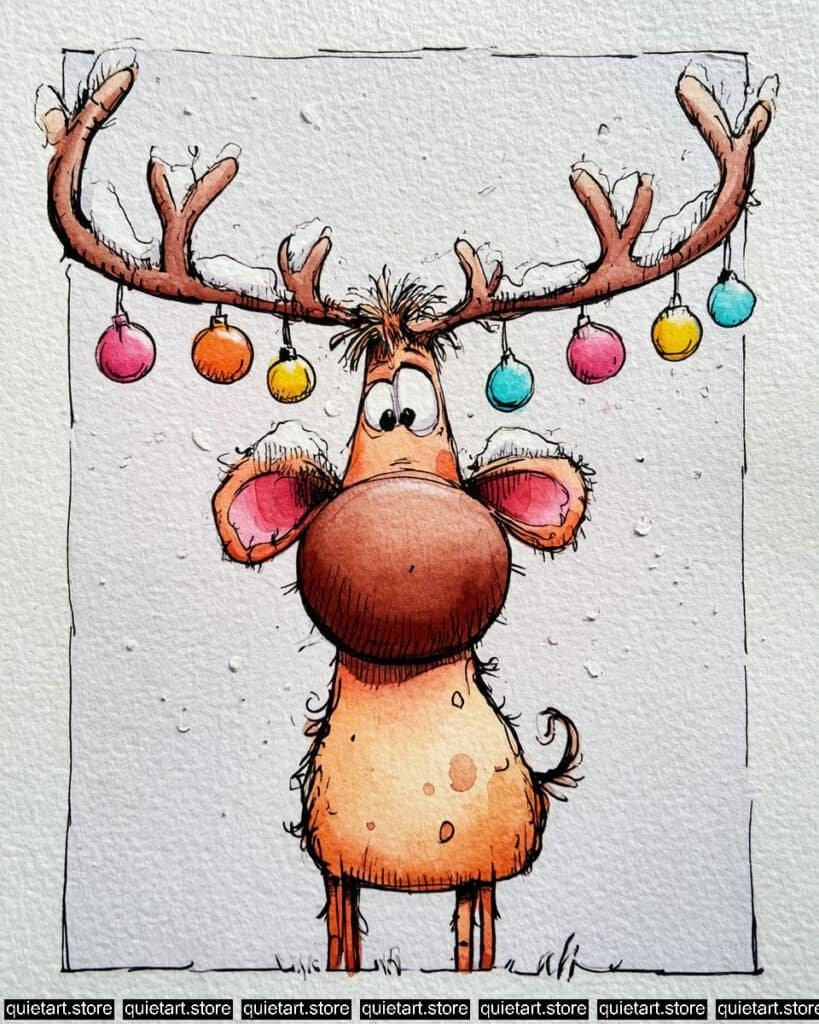
Start with a light pencil sketch to define the playful, exaggerated features of the reindeer, then trace over the lines using a fine waterproof ink pen for a whimsical ink-and-wash style. Apply a soft, pale gray or cool blue wash in the background, carefully leaving the snow caps on the antlers, ears, and ground completely white.
Once the background is dry, lay down initial warm washes of caramel brown on the body, a rich chestnut brown on the large snout, and bright pinks and vibrant tones for the inner ears and hanging ornaments. Finish by adding subtle shading and spots with a wet-on-dry technique, re-accentuating the ink cross-hatching, and dabbing opaque white gouache onto the antlers and ears for fluffy snow highlights.
Recommended Watercolor Pigments:
- Burnt Sienna & Raw Sienna (for the reindeer’s warm fur and body tone)
- Burnt Umber or Sepia (for the dark snout, hooves, and antler shading)
- Opera Pink or Quinacridone Rose (for the vibrant inner ears and pink Christmas ornaments)
- Cadmium Orange, Lemon Yellow, & Cobalt Teal (for the colorful hanging ornaments)
- Payne’s Gray (diluted heavily for the soft background sky wash and shadows)
- Permanent White Gouache (for snowy highlights on the antlers and ears)
Love these watercolor ideas? Get our 40 Christmas Watercolor Printable Coloring Pages (PDF Download) for even more fun, printable designs to paint this Christmas.
A funny white goose Christmas
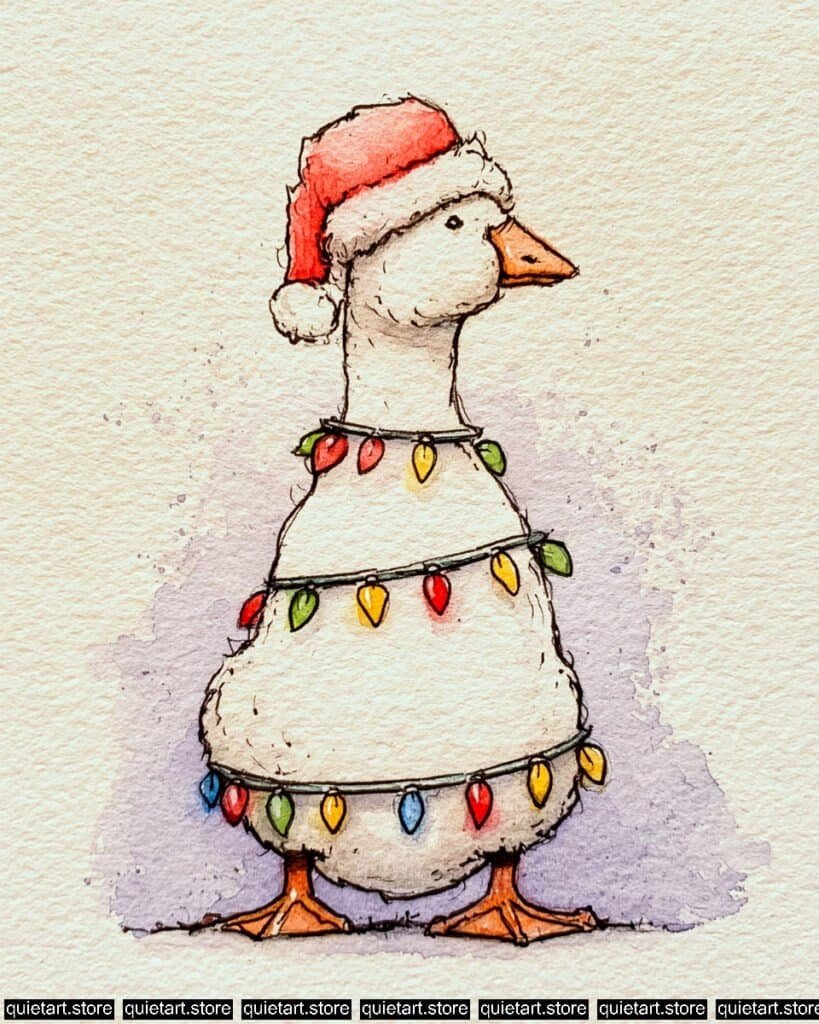
Begin with a light pencil sketch to outline the goose’s shape, Santa hat, and string lights, then trace over the contours using a fine waterproof ink pen for a clean, whimsical illustration style. Apply a soft, wet-on-wet lavender wash behind the goose, letting gentle watercolor splatters bleed outward to create an atmospheric, textured background.
Once the background is dry, wash the goose’s body with a very pale neutral tint or cool gray to suggest form while leaving the white paper showing through for the main feathers. Finish by painting the vibrant red Santa hat, bright orange beak and feet, and colorful light bulbs, then re-accentuate key ink lines and shadows to give the piece depth.
Recommended Watercolor Pigments:
- Cadmium Red Medium or Pyrrol Red (for the Santa hat and red Christmas lights)
- Cadmium Orange or Yellow Ochre (for the goose’s beak and feet)
- Dioxazine Violet or Ultramarine Violet (heavily diluted for the soft background splash and shadows)
- Hans Yellow Medium, Sap Green, & Phthalo Blue (for the yellow, green, and blue light bulbs)
- Payne’s Gray (diluted for the subtle shading on the white feathers)
- Permanent White Gouache (optional, for crisp highlights on the lights and fluffy hat trim)
Love these watercolor ideas? Get our 40 Christmas Watercolor Printable Coloring Pages (PDF Download) for even more fun, printable designs to paint this Christmas.
Christmas black raven
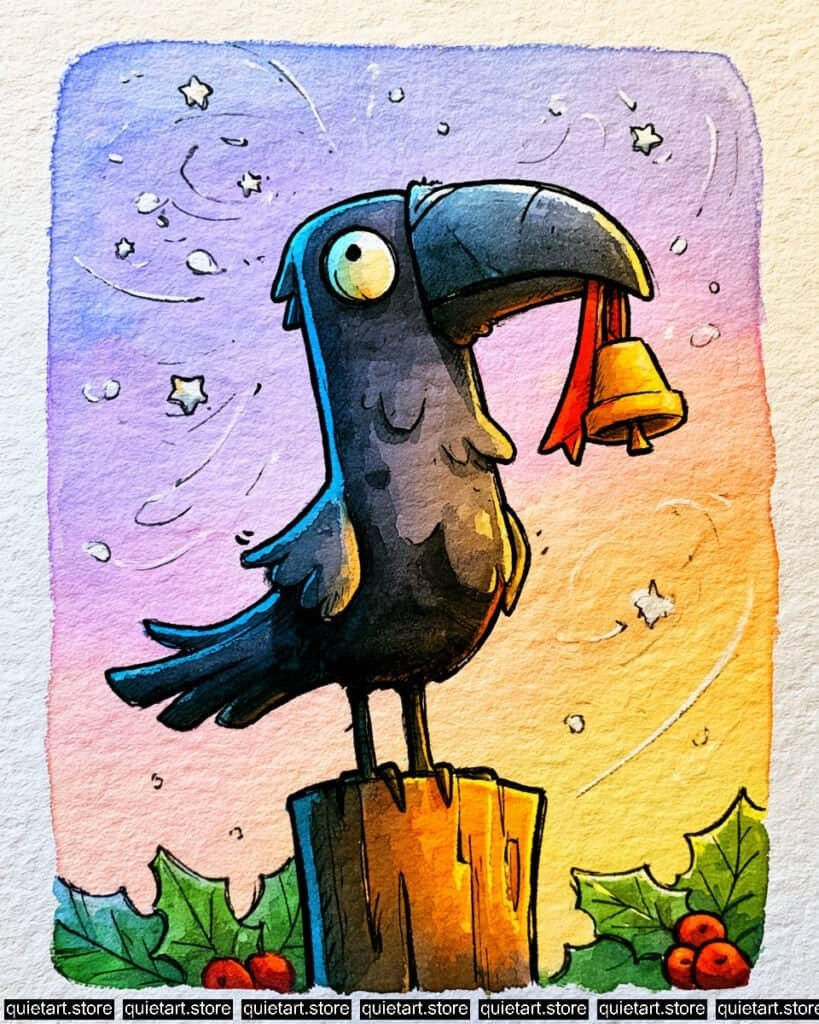
Begin by sketching the entire composition with a light touch, defining the central character and surrounding elements, and then go over the lines with a waterproof ink pen for a crisp illustrative look. Apply a soft wet-on-wet wash for the background, creating a smooth gradient from deep purple-blue at the top to bright yellow at the bottom, carefully painting around the stars. Lay down the first transparent washes of color for the crow, the post, the bell, and the holly.
Once the initial layers are dry, build depth and texture by layering darker pigments wet-on-dry, especially for the crow’s deep-toned feathers and the wood grain on the post, while ensuring the yellow highlights remain bright. Focus on sharp details, using a saturated red for the ribbon and berries, and a golden hue for the bell, carefully defining shadows with darker blues. For the finishing touches, add subtle shading in the eye and beak, and then carefully splatter white gouache for the final twinkling snowfall effect.
Recommended Watercolor Pigments:
- Ultramarine Blue & Dioxazine Violet (heavily diluted for the gradient sky, and mixed with burnt umber for the crow’s feathers)
- Burnt Umber & Quinacridone Gold (for the post and the golden bell)
- Cadmium Red or Pyrrol Red (for the vibrant ribbon and holly berries)
- Sap Green & Permanent Green Light (for the holly leaves)
- Permanent White Gouache (for the tiny snowflakes)
Love these watercolor ideas? Get our 40 Christmas Watercolor Printable Coloring Pages (PDF Download) for even more fun, printable designs to paint this Christmas.
Christmas chimney
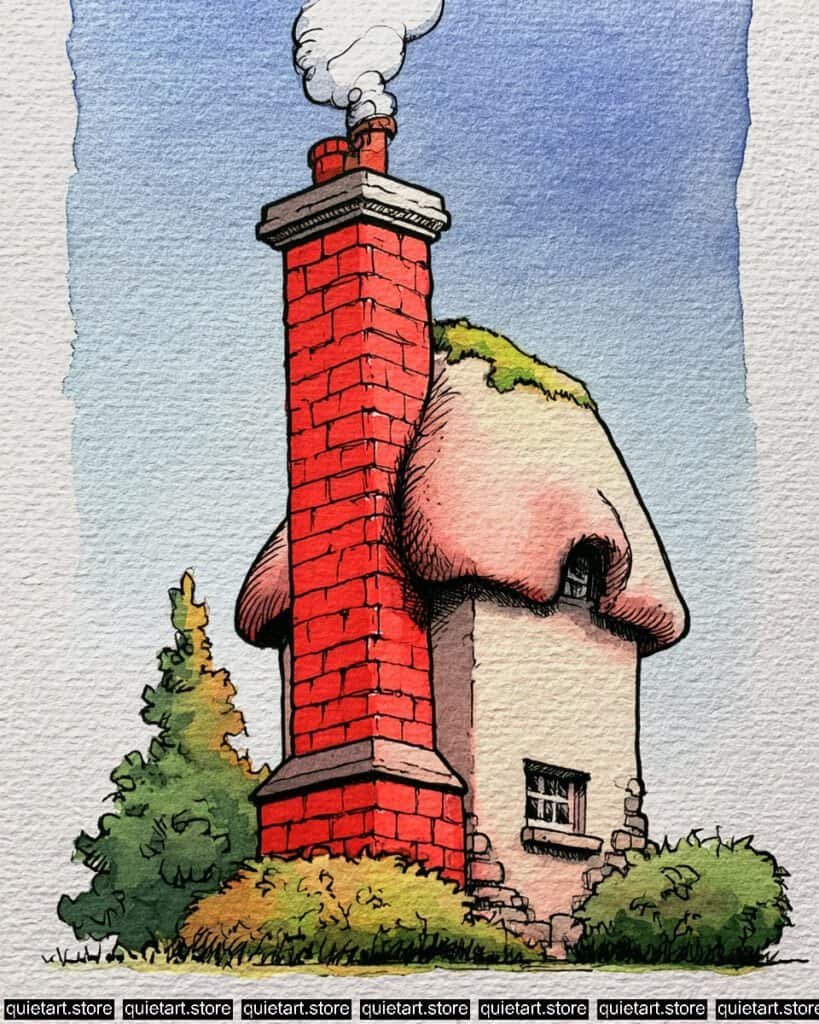
Begin by establishing the main structures with a confident waterproof fineliner ink, using hatching to define the shade on the chimney, the texture of the thatched roof, and the density of the shrubs. Once your line work is completely dry, apply your first transparent, light-valued washes, laying down a smooth blue-violet sky in the upper background and a pale cream or off-white tone on the cottage walls, allowing the white of the paper to provide the brightest highlights.
Next, build depth by layering more saturated pigments, using a vibrant brick red on the chimney and a warm terracotta or rosy wash on the dome-shaped thatched roof while it’s still damp to allow for subtle blending. Finish the piece by painting the foliage with various greens—keeping them warmer and more yellow at the top and cooler at the bottom—and then use a highly concentrated gray or diluted black to add final shadow definitions under the eaves, around the window sill, and within the curling smoke.
Recommended Watercolor Pigments:
- Ultramarine Blue: For the primary sky wash.
- Dioxazine Violet: To dilute and mix into the upper sky for that cool, slightly purple hue.
- Pyrrol Scarlet or Cadmium Red Medium: A vibrant red for the main chimney bricks.
- Burnt Sienna or Terra Ercolano: For the brick shading and mixing into the warm roof wash.
- Quinacridone Gold or Yellow Ochre: To mix into the roof, chimney bricks, and the top of the conifer tree for warmth.
- Sap Green: The primary color for the bushes and trees.
- Payne’s Gray: Heavily diluted for the subtle gray shading on the white walls, the chimney cement, and the smoke.
Love these watercolor ideas? Get our 40 Christmas Watercolor Printable Coloring Pages (PDF Download) for even more fun, printable designs to paint this Christmas.
Christmas highland cow
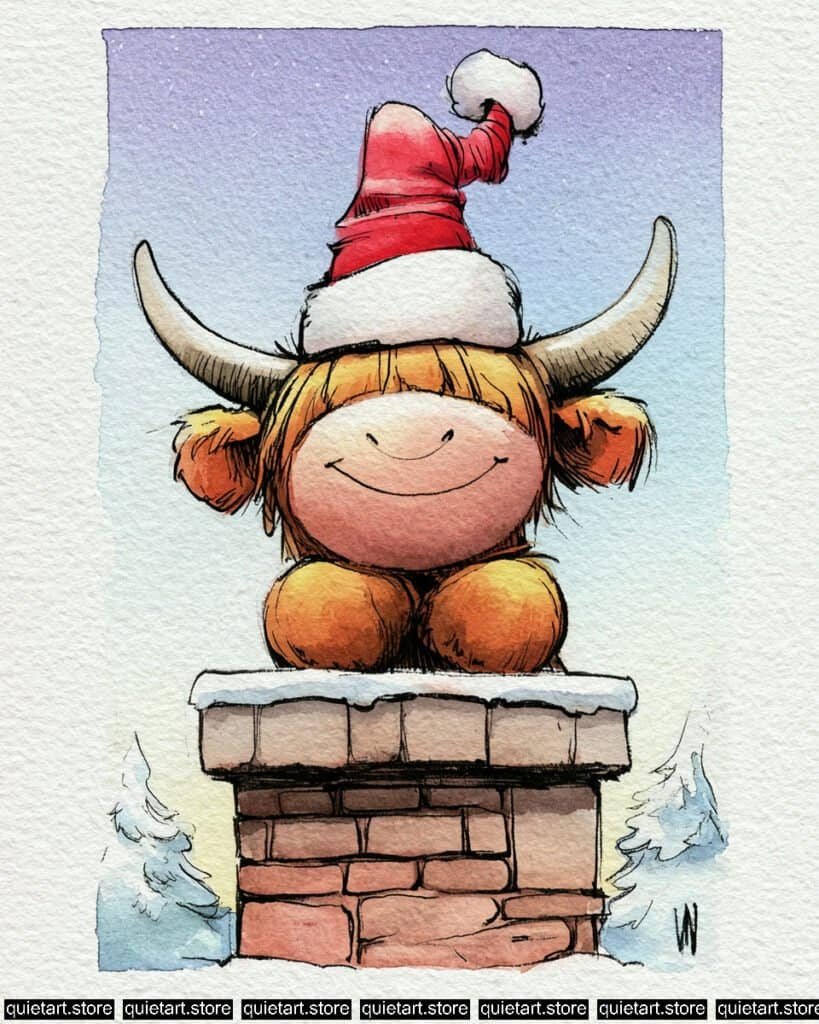
Start by making a light pencil sketch of the Highland cow sitting atop the brick chimney, then refine the details with a fine, waterproof ink pen to create expressive contours and cross-hatching. Apply a smooth wet-on-wet gradient background transitioning from soft purple-violet at the top to a faint sky blue near the horizon, making sure to leave the snow on the chimney and trees unpainted paper white.
Once the background is dry, lay down initial transparent washes of warm golden-ochre and rich orange-brown for the cow’s shaggy fur, followed by a bold red glaze for the Santa hat. Finish using a wet-on-dry technique to build depth in the stone brickwork, paint cool blue shadows on the snowy surfaces and hat brim, and splatter fine white gouache for a soft snowfall effect.
Recommended Watercolor Pigments:
- Burnt Sienna & Raw Sienna (for the warm, shaggy coat of the Highland cow)
- Cadmium Red Medium or Pyrrol Red (for the vibrant Santa hat)
- Yellow Ochre & Quinacridone Gold (for the golden fur highlights and warm muzzle)
- Dioxazine Violet & Cerulean Blue (diluted heavily for the soft background sky gradient)
- Payne’s Gray or Ultramarine Blue (heavily diluted for shadows on the snowy roof, hat trim, and distant trees)
- Venetian Red or Potter’s Pink (for the muted, natural red-orange tones in the brick chimney)
- Permanent White Gouache (for subtle white snowy accents and fine splatters)
Love these watercolor ideas? Get our 40 Christmas Watercolor Printable Coloring Pages (PDF Download) for even more fun, printable designs to paint this Christmas.
Christmas Llama
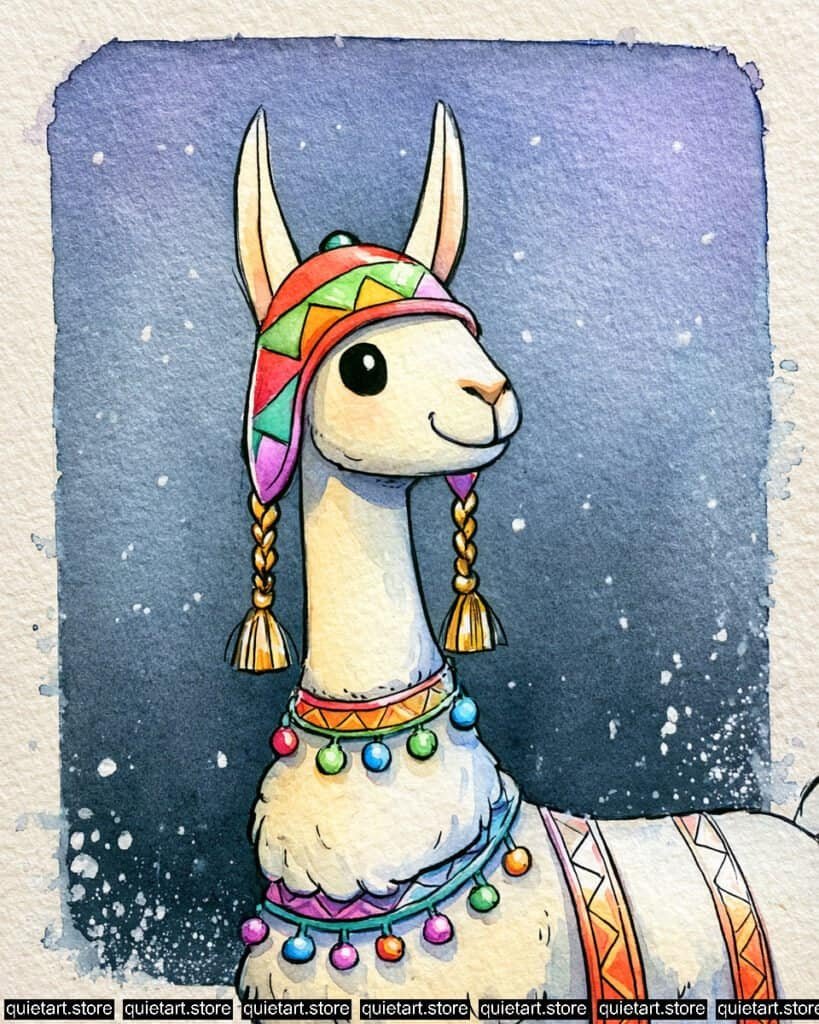
Start with a detailed pencil sketch of the llama and all its accessories, then refine the major contours using a fine waterproof ink pen to create a crisp illustrative style. Apply a wet-on-wet wash across the background within the defined border, transitioning smoothly from a warm lavender-blue at the top to a deeper cobalt-grey at the bottom, carefully working around the llama figure. While the background is still wet, splatter some clean water or highly diluted white paint to create soft, out-of-focus snowflake effects.
Once the background is dry, apply a very light, pale neutral wash over the llama’s body and face to suggest texture, preserving the bright white of the paper. Next, use saturated colors with a precise wet-on-dry technique to paint the small details of the festive hat, patterned blanket, and all the individual pom-poms with bright jewel tones. Finally, apply a highly opaque white gouache splatter over the entire piece to create sharp, in-focus snowflakes for the final wintery touch.
Recommended Watercolor Pigments:
- Cobalt Blue (diluted for the softer background sky)
- Dioxazine Violet (for the upper background gradient and hat details)
- Indigo (for the dark shadow at the bottom of the background)
- Cadmium Red Medium or Pyrrol Red (for the main color on the hat and red pom-poms)
- Hans Yellow Medium or Azo Yellow (for the yellow triangles on the hat and pom-poms)
- Sap Green & Turquoise Blue (for the teal/green hat details and pom-poms)
- Quinacridone Gold (for the tassels, fur highlights, and general warmth)
- Permanent White Gouache (for all snowflake details)
Love these watercolor ideas? Get our 40 Christmas Watercolor Printable Coloring Pages (PDF Download) for even more fun, printable designs to paint this Christmas.
Christmas Peak Cabin

Start by creating a detailed pencil sketch of the cabin perched atop the rocky cliff, pine trees, and distant landscape, then reinforce all main outlines and shadow lines using a fine waterproof ink pen. Apply a soft wet-on-wet wash across the background, smoothly blending bright yellow and warm orange near the left horizon into clear cerulean blue at the top sky, while laying down a soft violet wash for the distant mountain ridge below.
Once the initial background is dry, use a precise wet-on-dry technique to paint the main focal points, using warm ochre tones for the glowing windows and rock highlights, deep slate blue for the roof and cliffs, and rich evergreen tones for the trees. Finish by adding saturated red accents to the chimney, door, and gifts, carefully dotting colorful pigments onto the Christmas tree ornaments, and using dry-brushing or extra pen work to accentuate the rugged cliff textures.
Recommended Watercolor Pigments:
- Cerulean Blue & Cobalt Blue (for the vibrant sky, cabin roof, and cool shadows on the cliffs)
- Cadmium Yellow & Cadmium Orange (for the glowing sunset, lit windows, and star topper)
- Sap Green & Hooker’s Green (for the pine trees and surrounding bushes)
- Cadmium Red or Pyrrol Red (for the red door, chimney, and festive accents)
- Dioxazine Violet or Ultramarine Violet (for the distant hazy purple mountains)
- Raw Sienna & Payne’s Gray (for the sunlit faces and shaded crevices of the rocky peak)
Love these watercolor ideas? Get our 40 Christmas Watercolor Printable Coloring Pages (PDF Download) for even more fun, printable designs to paint this Christmas.
Christmas red brick cottage
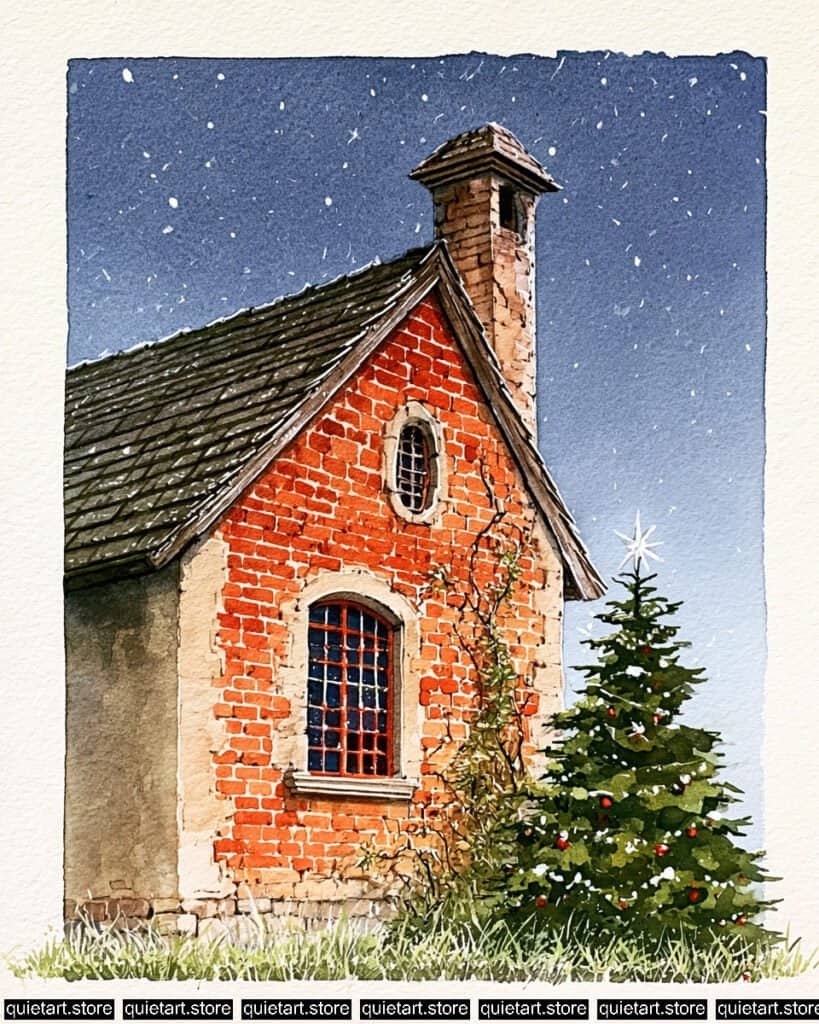
Start with a precise pencil sketch of the cottage, tall chimney, roofline, and Christmas tree, then define the major structural contours and window grilles with a fine waterproof ink pen. Apply a soft wet-on-wet gradient across the background sky, blending deep indigo at the top into a pale sky blue near the horizon, leaving the crisp edges of the cottage roof untouched.
Once the initial background wash is dry, use a wet-on-dry technique to paint the red brick facade, shingled roof, stone chimney, and dark evergreen tree with rich, saturated glazes. Finish by layering cool shadows along the side wall and under the eaves, adding small red ornament accents to the tree, and flicking white gouache across the sky and foliage to create falling snow and sparkling highlights.
Recommended Watercolor Pigments:
- Indigo & Cobalt Blue (for the deep starry sky gradient and window glass reflections)
- Pyrrol Red or Cadmium Red Medium (for the vibrant brick facade and Christmas ornaments)
- Burnt Sienna & Raw Sienna (for the stone chimney, brick mortar accents, and warm wall reflections)
- Hooker’s Green & Perylene Green (for the dark evergreen tree and surrounding foliage)
- Payne’s Gray or Sepia (for the roof shingles, structural shadows, and window frame details)
- Permanent White Gouache (for the falling snow, star topper, and snowy highlights on the tree and grass)
Love these watercolor ideas? Get our 40 Christmas Watercolor Printable Coloring Pages (PDF Download) for even more fun, printable designs to paint this Christmas.
Christmas robin

Begin with a soft pencil sketch to capture the robin’s plump silhouette and Santa hat, then trace over the outlines with a fine waterproof ink pen for clean illustrative contours. Apply a vivid wet-on-wet wash across the robin’s chest and the main body of the hat, blending bright yellow into warm red-orange and crimson to achieve a glowing gradient.
Once the initial washes begin to set, use a wet-on-dry technique to paint cool violet and sky blue shadows along the white fluffy hat trim, pom-pom, and lower belly. Finish by layering earthy brown glazes onto the robin’s wing and tail, painting the small holly sprig with vibrant green and red accents, and adding delicate hatch marks and subtle grey snow specks around the background.
Recommended Watercolor Pigments:
- Cadmium Red Light or Pyrrol Red (for the vibrant Santa hat, red breast, and holly berries)
- Hans Yellow Medium or Azo Yellow (for the warm yellow glow on the hat peak and upper chest)
- Burnt Sienna & Raw Umber (for the soft brown tones on the wing and tail feathers)
- Dioxazine Violet & Cerulean Blue (diluted heavily for the cool shadows on the hat trim, belly, and snowy ground)
- Sap Green or Permanent Green Light (for the holly leaves held in the beak)
- Payne’s Gray (diluted for the background snow dots and floor shadows)
Love these watercolor ideas? Get our 40 Christmas Watercolor Printable Coloring Pages (PDF Download) for even more fun, printable designs to paint this Christmas.
Christmas brick cottage window
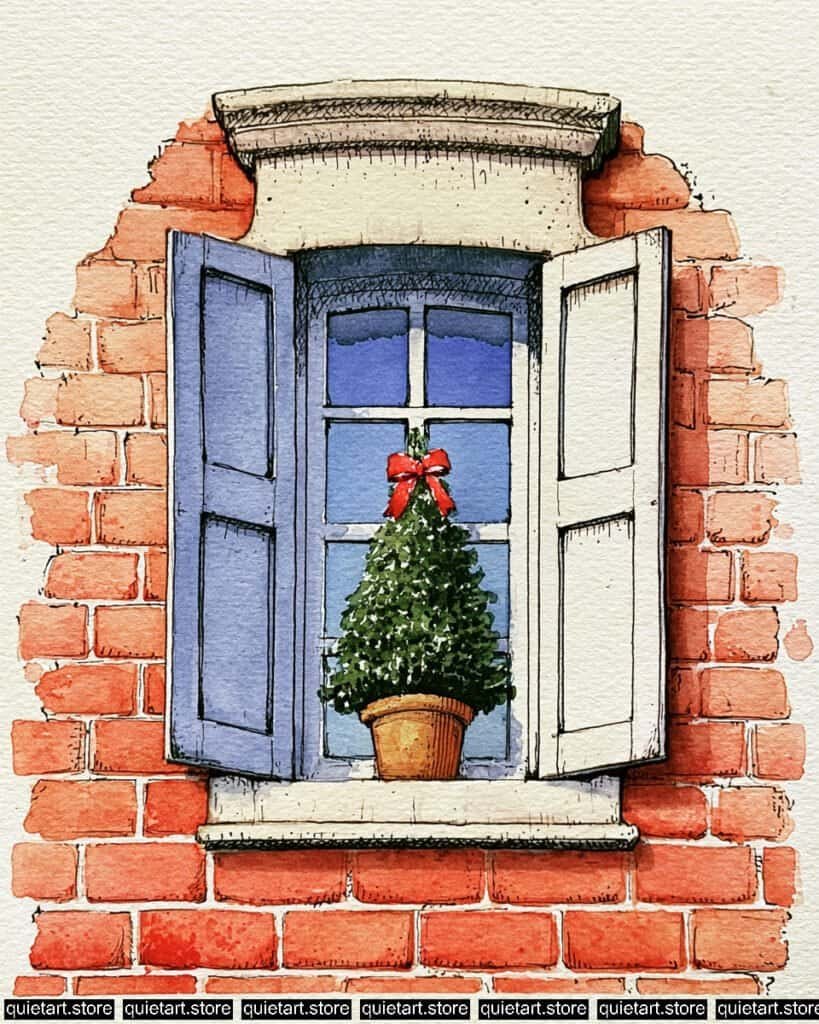
Start with a precise pencil sketch of the window, shutters, stone headers, and brick wall, paying close attention to perspective. Define the main outlines and shadow areas using a fine waterproof ink pen to create the line-art base for this illustrative piece. Lay down your first light, transparent washes for the sky, building walls, and the background of the tree, allowing the initial ink work to show through.
Once the background washes are completely dry, build depth by layering deeper pigments with precise wet-on-dry techniques for the brick facade, blue shutters, and terracotta pot. Paint the topiary with different green tones to create form, followed by a bold red for the festive bow. Finish by layering cool gray-blue shadows on the white trim, re-accentuating key pen lines, and dabbing white gouache over the green foliage for clean snowy accents.
Recommended Watercolor Pigments:
- Pyrrol Red or Cadmium Red Medium (for the vibrant bow and a component of the bricks)
- Cobalt Blue (for the sky, a component of the muted blue shutters, and distant window reflections)
- Perylene Green (for the main color of the topiary)
- Sap Green (for lighter foliage highlights)
- Burnt Sienna (mixed into the red for warm, natural brick tones and the pot base)
- Yellow Ochre or Raw Sienna (diluted heavily for stone trim and window framing warmth)
- Payne’s Gray (diluted for the shadows on white surfaces and structural details)
- Permanent White Gouache (for the crisp snowy highlights on the tree)
Love these watercolor ideas? Get our 40 Christmas Watercolor Printable Coloring Pages (PDF Download) for even more fun, printable designs to paint this Christmas.
Cottage Christmas tree

Begin by sketching the cottage, Christmas tree, and pile of gifts with a light pencil. Use a fine-liner waterproof pen to trace all the outlines and add the cross-hatching detail for texture on the thatch, brickwork, and gifts, as seen in the sample image. For the background, apply a loose, graded wet-on-wet wash of warm orange, allowing the color to fade softly into the white of the paper.
Start with light washes, painting the cottage walls in a pale cream and the grass with light green. Next, use a wet-on-dry technique to apply richer colors, including deep greens for the tree, vibrant red for the gifts and ornaments, and earthy browns for the door, windows, and chimney. Add final, darker glazes for deep shadows on the ground, within the windows, and beneath the gifts to build contrast, and paint the subtle smoke curl rising from the chimney.
Specific Watercolor Pigment Recommendations:
- Azo Yellow or New Gamboge: (Heavily diluted for the warm orange background wash and windows)
- Pyrrol Scarlet or Cadmium Red: (For the gifts, tree baubles, and mixing for the warm brick tones)
- Burnt Sienna: (For the cottage walls, door, window frames, chimney, and ground)
- Sap Green: (For the primary color of the tree and grass)
- Hooker’s Green: (Mixed into the tree and grass for deeper greens)
- Neutral Tint: (Diluted for the subtle smoke, and for mixing into greens/browns for deep shadows)
Love these watercolor ideas? Get our 40 Christmas Watercolor Printable Coloring Pages (PDF Download) for even more fun, printable designs to paint this Christmas.
Conclusion
Capturing the warmth and magic of the holidays through watercolor painting is a wonderful way to celebrate the winter season.
We hope these 28 cozy ideas inspire you to pick up your brushes and explore new techniques. Don’t forget to download your favorite printable coloring pages to jumpstart your next creative project!