
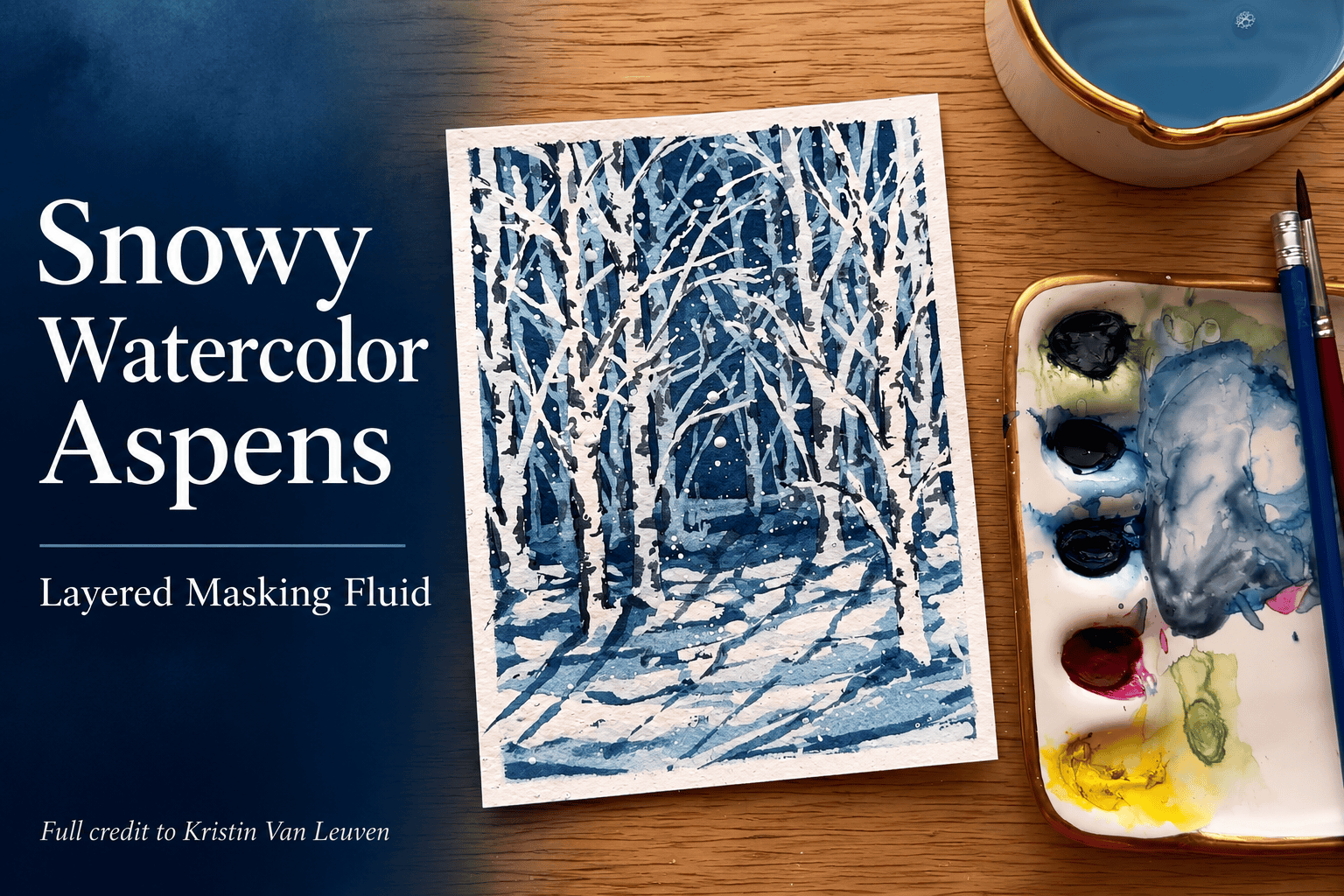
A snowy forest can look intricate long before its painting process becomes complicated. In this watercolor tutorial, Kristin Van Leuven builds a woodland of bright trunks, delicate branches, and blue shadows by alternating masking fluid with increasingly dark washes.
The unusual part is where the masking goes: some protects the original white paper, while later applications preserve color already painted underneath. Her aspen-inspired scene becomes a practical introduction to layered masking, with depth emerging gradually from a small range of blues.
How Layered Masking Creates a Snowy Forest
Masking fluid often appears at the beginning of a watercolor painting, where it covers areas intended to remain white. Kristin extends that familiar use by adding it over dry watercolor. Each new application protects the particular blue beneath it, allowing the next wash to become darker without covering every earlier shape.
The forest therefore develops through several distinct values. The nearest trees retain the paper’s white, another group holds a pale blue, and more distant trunks preserve a middle blue. A final dark wash fills the remaining spaces. Those differences make overlapping branches easier to read and help the trees recede into the woodland.
Her goal is the feeling of an aspen forest rather than a precise botanical study. Narrow trunks and long, spindly branches establish that character. The brightest foreground trees receive the clearest details later, while the darker trees behind them gradually disappear into the scene.
Preparing the Brush and First Masking Layer
Kristin uses colored Winsor & Newton masking fluid and a rigger, also called a liner brush. Its long, narrow bristles suit the slender trunks and branching lines that run through the painting. The tint makes the reserved shapes visible while she works, even though their eventual colors remain hidden underneath.
Before applying the fluid, she massages dish soap into the brush bristles. After each masking session, she rinses the brush thoroughly and repeats the soap treatment before the next application. She presents this as a routine that has worked well for her brush, rather than a guarantee for every brush or masking product.
Reserving the Brightest Trees and Snow
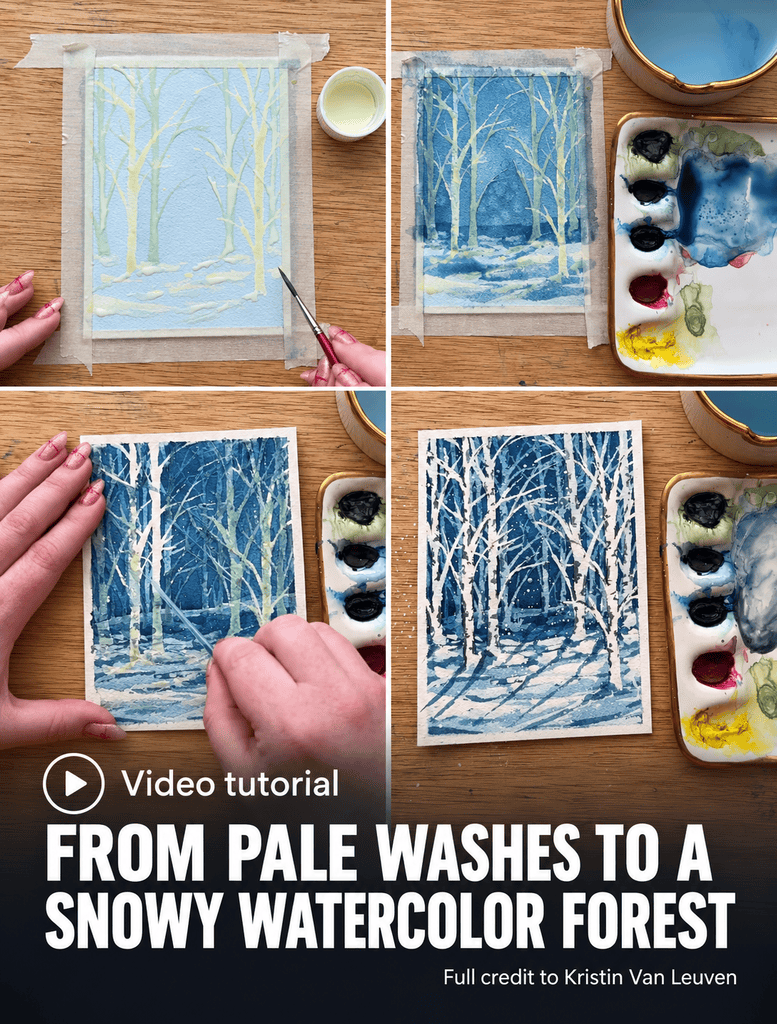
The first masking layer goes directly onto the paper. These marks establish the larger foreground trees, including their narrow offshoots and longer branches. Because no watercolor sits beneath this layer, the protected shapes will become the brightest parts of the woodland when the masking is removed.
She also reserves small areas of snow across the ground and near the horizon. These irregular shapes provide white interruptions that will remain visible through the later washes. A few scattered marks come from tapping the loaded brush with a pencil or another brush, creating small protected spots around the composition.
This opening stage establishes more than tree outlines. It also begins the snowy ground, giving the later blue shadows something to surround. Kristin allows the masking fluid to dry completely before covering the scene with watercolor.
A Pale Cerulean Wash Sets the Starting Value
The first wash is a very light Cerulean blue, mixed with plenty of water and spread across the scene. Kristin keeps it only a little darker than white. Starting this gently leaves room for the next washes to grow progressively deeper without losing the differences between them.
At this point, the masking protects the original white shapes while the exposed paper takes on blue. That pale color is not merely an early background. Some of it will become the visible color of the second group of trees once another layer of masking is added.
Dry Paint Before the Next Masking Application
Kristin emphasizes that the watercolor must be completely dry before masking fluid goes over it. She uses a hair dryer during the demonstration and checks that the painted surface is ready before continuing. The repeated drying stages are central to the sequence, separating each protected color from the wash that follows.
She also discusses paper tearing during masking removal. Her advice centers on textured, 100% cotton paper and a painted surface that is bone dry before another masking layer is applied. These are the conditions she recommends for this approach; the demonstration does not suggest that every paper will respond identically.
Masking Over Blue to Add Another Group of Trees
With the pale wash dry, Kristin draws more trees in masking fluid. These new shapes will preserve the light blue underneath them. Their branches can intertwine with the foreground trees, giving the forest a more connected, irregular structure.
She extends the same idea into the snow, masking pale blue patches near some of the existing white reserves. The ground can then retain both bright snow and lighter blue areas when another wash passes over it. The changes in value begin to describe an uneven snowy surface.
She avoids covering too much of the painting at this stage. Later trees and the darkest background still need open space. Each reserved branch occupies an area that subsequent watercolor cannot reach, so the gaps between the masking marks matter alongside the marks themselves.
Deepening the Scene with Indigo
After the second masking layer dries, Kristin adds Indigo to the Cerulean mixture for a darker wash. This blue needs to be noticeably deeper than the first, while still leaving room for the final background to become darker again.
During this stage, she adds a little salt to the wet paint. The broader structure of the painting, however, continues to depend on the alternating washes and protected shapes. The trees gain their different values because each masking application preserves a different stage of the blue.
She also develops the darker area around the horizon and adds shadow marks across the ground. Repeating the slope near the back of the scene helps connect the distant forest to the snow below it. The painting is developing as a landscape, rather than as separate tree shapes placed over an unrelated foreground.
The Last Masking Layer Preserves the Middle Blue
Once the middle wash is fully dry, another application of masking fluid establishes smaller, more distant trees. These marks protect the medium blue, producing trunks that will sit closer in value to the dark woodland behind them.
Kristin sometimes carries fresh masking over an existing masked area so that a new trunk or branch remains continuous. Mentally following the new tree through an overlap helps its lines connect, even when an earlier tree temporarily obscures part of the route.
Although this layer fills more of the scene, she still leaves unmasked spaces. Those openings will receive the darkest paint and separate the branches. Covering nearly everything would remove the contrast that makes the individual tree shapes visible after the masking comes away.
Why the Sequence Ends with Paint
The last major layer is watercolor, not another application of masking fluid. Kristin deepens the remaining background enough to distinguish it from the protected middle blue. Without that difference, the most distant reserved trees would have less separation from their surroundings.
The effect relates to negative painting: dark areas define the lighter tree shapes around them. Here, masking fluid protects the branches while the surrounding spaces receive paint. The scene can become densely interwoven without requiring every narrow branch to be carefully avoided during each wash.
She brings the dark color down toward the established horizon and pulls quick shadow strokes into the snow. White, pale blue, middle blue, and dark blue now work together across both the forest and the ground.
Revealing the Trees and Shaping the Snow Shadows
After the painting dries, Kristin removes the tape and then the masking fluid. The yellow-tinted shapes that dominated the working stages give way to white and blue trunks. This reveal makes the purpose of each earlier wash much clearer: the different tree colors were already present beneath their protective layers.
The foreground trees now need shadows that connect them to the snow. Using dark blue already present elsewhere in the painting, she extends cast shadows from their bases. Slight curves in the strokes suggest the lumps and dips of the snowy surface.
These shadows support the depth established by the trees. The palest trunks stand forward, while their darker marks travel across a ground already broken into several values. Kristin deepens selected snowy areas further as the painting develops, strengthening the relationship between the trunks and the terrain beneath them.
Bark Details Change with Distance
For the bark, Kristin mixes a cool black from her palette, using mainly magenta, yellow, and Cerulean with a small amount of sap green. Mixing the dark herself allows her to adjust its color bias as she works.
She adds irregular lines, knots, grooves, and small shapes rather than repeating an identical pattern on every trunk. These marks suggest bark while preserving the loose character of the woodland. Their strength changes depending on where each tree sits in the scene.
The white foreground trunks receive the darkest, most vivid, and most precise marks. Farther back, the blue trees have lighter, looser, more washed-out details. This difference reinforces the distance already suggested by the layered washes. A background tree does not need the same crisp attention as one standing near the front.
Even with many crossing branches, the scene remains readable because its values and details are differentiated. The layering establishes which trees come forward, and the bark marks strengthen that ordering.
A Final Scattering of White Gouache
Kristin finishes with white gouache, slightly diluted so that it moves from the brush more easily. Tapping the brush with a pencil sends small white splashes across the painting, echoing the earlier tapping technique used with masking fluid.
The two methods arrive at light marks in different ways. The early masking preserved the paper beneath the washes, while the final gouache adds white over the completed painting. Together, they contribute to the snowy atmosphere without replacing the value structure underneath.
The finished woodland demonstrates how masking fluid can preserve an entire progression of color. Its bright trunks, quieter blue trees, dark gaps, and curved snow shadows develop through a repeated sequence of masking, drying, painting, and drying again. Kristin’s aspen-inspired forest gives that sequence a clear purpose: each protected layer becomes another visible distance within the winter scene.