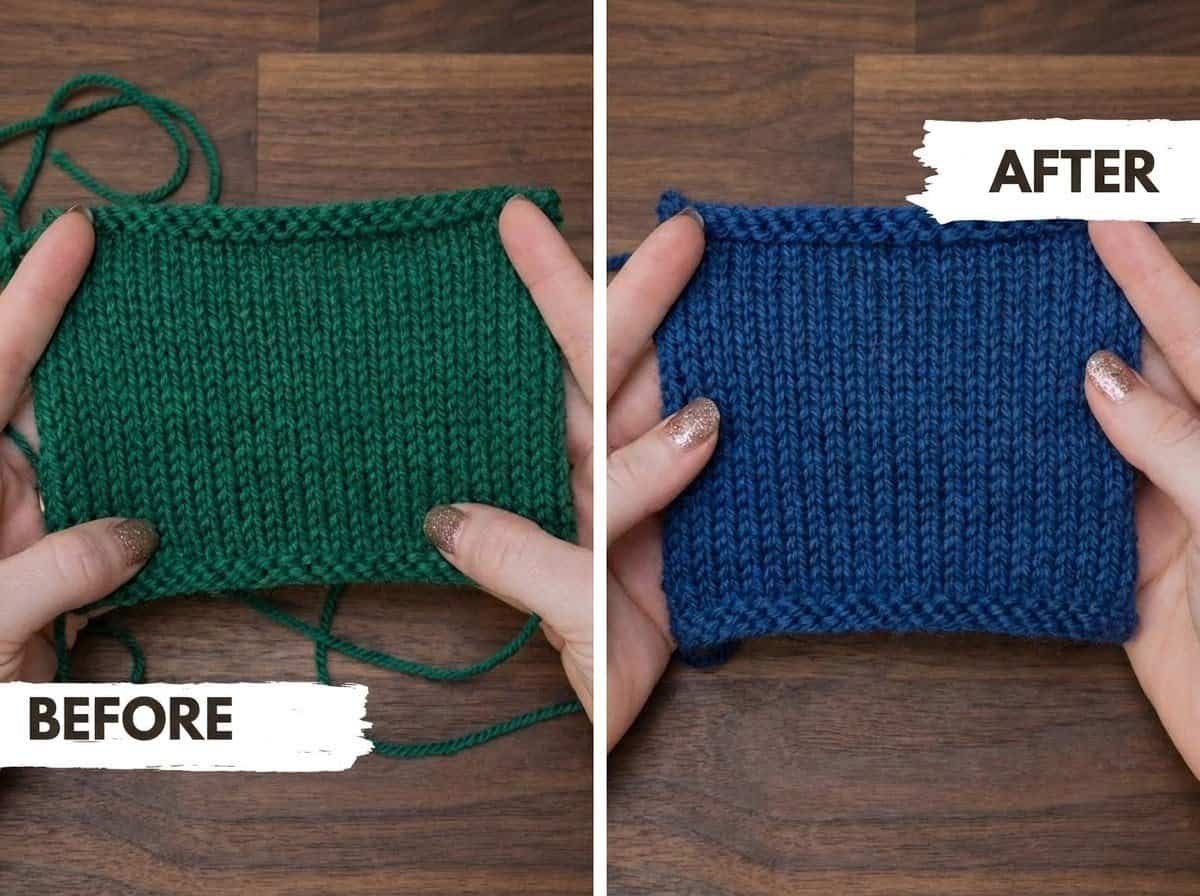
Good knitting tension can completely change the look of a finished fabric. Even when the stitch pattern is simple, uneven loops, loose purl rows, and visible “gutters” can make the fabric look bumpy or inconsistent.
In her tutorial, Clo Knits focuses on exactly that problem: how to improve tension with small changes in technique, especially when knitting flat in stockinette stitch.
Her main point is that washing and blocking can help smooth a project, but they cannot completely fix major tension problems. To create cleaner fabric, knitters need to understand where the unevenness comes from and how their needles are shaping each stitch.
What Rowing Out Looks Like in Knitting
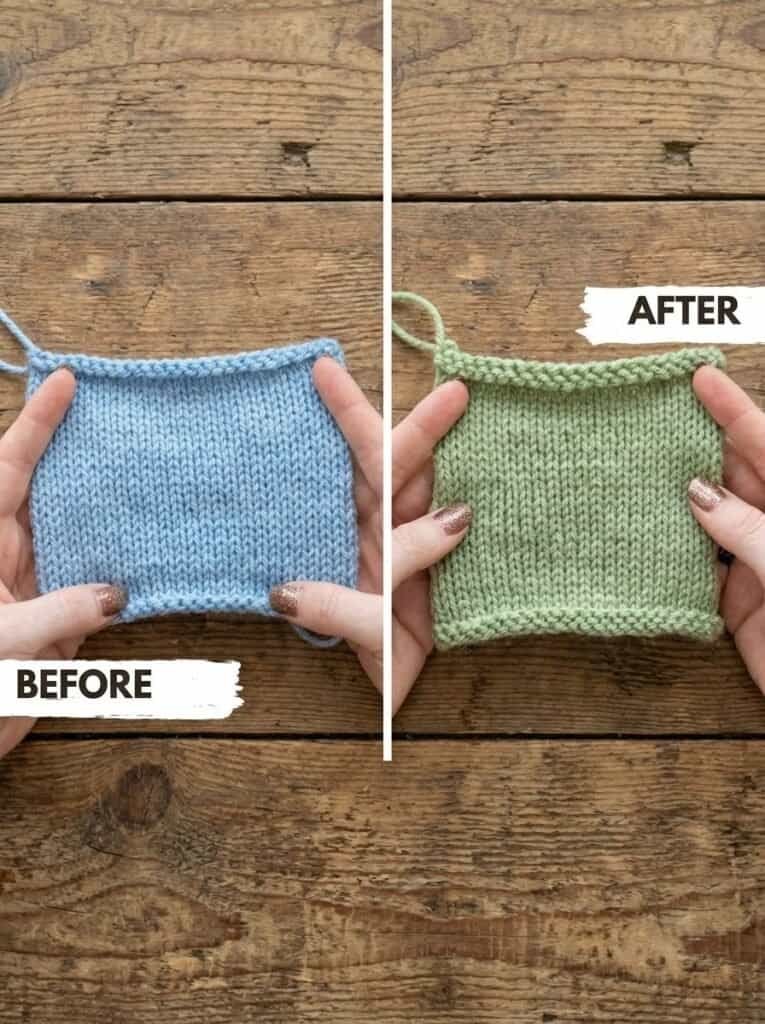
Clo begins by comparing several swatches.
One swatch was knitted entirely in the round, so every row consisted of knit stitches. Another was worked flat, alternating knit and purl rows. A third was intentionally knitted with tension problems.
The contrast is easiest to see from the wrong side.
Look at the Back of the Fabric
On the uneven swatch, some rows form much deeper ridges or “gutters” than others.
When the fabric is stretched, every other row looks noticeably larger. Clo identifies those larger rows as the purl rows.
The knit rows appear more stable and consistent, while the purl rows contain larger and less regular stitches.
This difference between knit and purl tension is one reason why a knitter’s gauge can change between knitting flat and knitting in the round.
Clo notes that purl stitches may naturally be a little larger because of the way the yarn is wrapped around the needles, but the difference can often be reduced enough that it becomes difficult to see.
Start by Improving the Knit Stitch
Before focusing on purling, Clo recommends understanding how to create a well-sized knit stitch.
The most important idea is to let the needle determine the stitch size.
Keep Stitches Near the Needle Tip
Clo moves the stitches close to the tapered section of the left needle.
When she is ready to knit the next stitch, she brings it toward the point where the needle begins to narrow.
This creates room to insert the right needle without unnecessarily stretching the existing stitch.
If the stitch stays farther down on the full-width shaft and the right needle is forced into it, the loop can become larger before the new stitch is even formed.
That movement can also distort the stitch underneath.
Let the Needle Measure the New Stitch
Once the stitch is entered, Clo wraps the yarn and pulls the new loop through.
But she does not immediately yank the stitch away from the needle.
Instead, she brings the new stitch far enough onto the full-width section of the right needle so that the needle shaft measures its size.
Her sequence is essentially:
Enter the stitch, create the loop, bring it onto the full circumference of the needle, and then move on.
Avoid Pulling Before the Stitch Is Sized
If the loop stays near the narrow needle tip and the yarn is pulled tight immediately, the stitch has not been properly measured by the needle.
Clo demonstrates the same concept in both Continental and English-style knitting.
The hand movements may differ, but the principle stays the same: the needle controls the size of the loop, while the knitter focuses on wrapping and moving the yarn.
How to Check Your Knit Tension
Clo offers two simple ways to assess whether the stitches are being sized correctly.
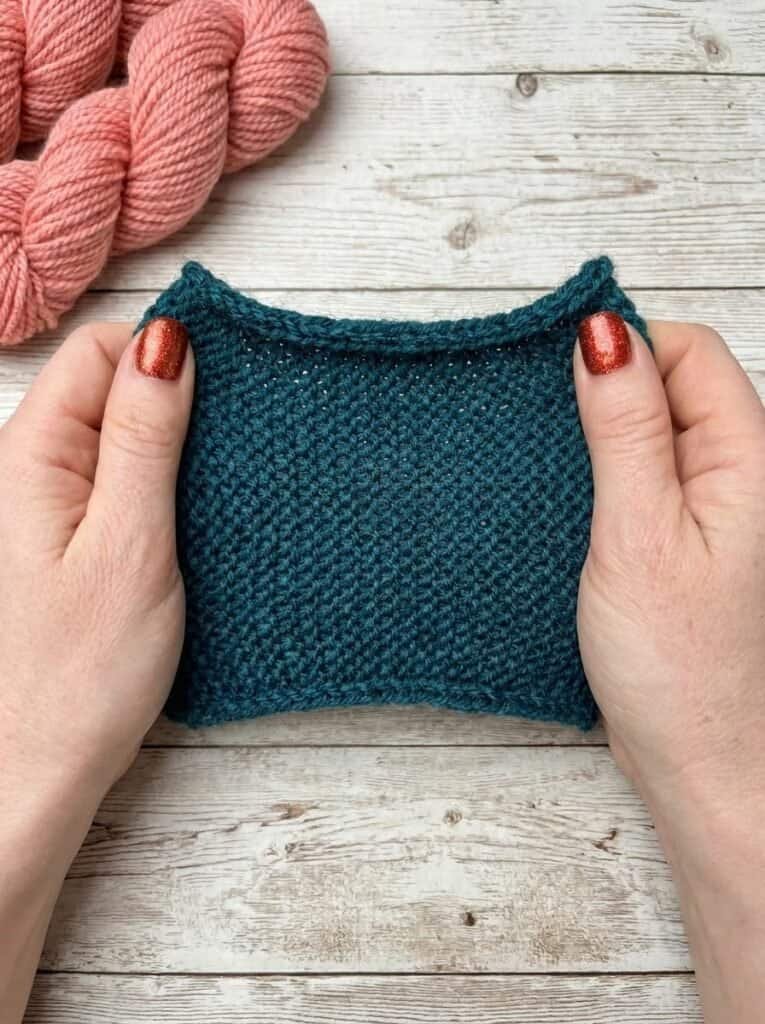
First, when the work is relaxed, there should not be a large visible gap between the stitch and the row beneath it.
The loops should hug the needle fairly closely.
Second, the stitches should still slide freely along the needle.
Tight Does Not Mean Better
If the stitches become stuck and difficult to move, the knitter is pulling too tightly.
The goal is not to create the smallest possible loop.
Instead, the stitches should fit comfortably around the needle while still moving easily.
This balance allows the needle to act as a consistent measuring tool from one stitch to the next.
Apply the Same Principle to Purl Stitches
Purl rows are often where rowing out becomes most obvious.
Clo recommends using the same approach as with knit stitches.
Move the stitches toward the needle tip, enter the stitch, wrap the yarn, and then bring the new loop onto the full-width shaft before letting the old stitch fall off.
Keep the Needles Close Together
She also focuses on keeping the needle tips relatively close and maintaining a consistent angle.
After pulling the new loop through, it can be tempting to move the working needle far away or yank the yarn.
That movement can create an oversized purl stitch.
Instead, Clo brings the loop back onto the shaft, lets the needle measure it, and then removes the old stitch.
She demonstrates the same concept with both English and Continental purling.
Try a Smaller Needle for Purl Rows
If the difference between knit and purl rows is still dramatic, Clo suggests a more mechanical solution.
When working flat, the knitter can use a smaller needle for the purl rows.
This can compensate for naturally looser purl stitches and help the two row types match more closely.
A Useful Fix, but Not Necessarily a Permanent One
Clo describes this method as something of a “crutch.”
It works, and if a knitter is satisfied with the result, there is nothing wrong with continuing to use it.
However, someone who wants to address the underlying tension difference may prefer to experiment with a different purling technique instead.
Experiment With Different Ways to Purl
Clo presents several alternatives for knitters who continue to struggle with purl-row tension.
One possibility is backward knitting instead of turning the work and purling in the usual way.
This can create stitches that are more consistently measured by the needle.
Another option is changing knitting styles.
English, Continental, and Combination Purling
Someone accustomed to English-style purling could experiment with Continental purling, or vice versa.
Clo also mentions combination-style purling.
In this method, the yarn is wrapped in the opposite direction, which changes how the stitch is mounted on the needle.
On the following knit row, those stitches need to be worked through the back loop to avoid twisting them.
For a knitter comfortable with knitting through the back loop, Clo says this can work very well.
Portuguese and Norwegian Purling
Other options include Portuguese knitting and Norwegian purling.
Clo notes that Norwegian purling can stretch the stitch below because of the additional movement required to reach and manipulate the yarn.
For some knitters, that extra stretching may help balance an existing tension problem.
For her own knitting, however, she finds it more difficult to maintain consistent stitch size with this method.
The larger lesson is that there is no single purling method that will work best for everyone.
The goal is to find an approach that makes it easier to form consistently sized loops.
Fiber Choice Can Reveal Tension Problems
Yarn fiber also affects how visible tension differences become.
Clo explains that wool is generally more forgiving because it has natural stretch.
Small inconsistencies may become less noticeable in wool.
Plant Fibers Show More
When switching to fibers such as cotton or linen, tension issues can become much more obvious.
Because those fibers behave differently, a knitter who feels comfortable with wool may suddenly notice uneven stitches when using a new yarn base.
For that reason, Clo recommends practicing on a swatch when changing fibers.
This gives the knitter a chance to adjust technique before starting the main project.
Conclusion
Improving knitting tension is not necessarily about pulling the yarn tighter.
According to Clo Knits, one of the biggest improvements comes from allowing the knitting needle itself to determine the size of each stitch.
Keeping stitches near the tapered tip makes them easier to enter without stretching. Bringing each new loop onto the full-width needle shaft gives it a consistent measurement. Maintaining a steady needle angle and avoiding unnecessary pulling can help both knit and purl rows become more even.
If purl rows remain significantly looser, knitters can experiment with a smaller needle, backward knitting, another purling style, or techniques such as combination, Portuguese, or Norwegian purling.
Most importantly, washing and blocking should not be expected to erase major tension problems.
By paying attention to how each loop is created and measured, knitters can gradually reduce rowing out and produce flatter, cleaner, and more consistent fabric—whether they work flat or in the round.