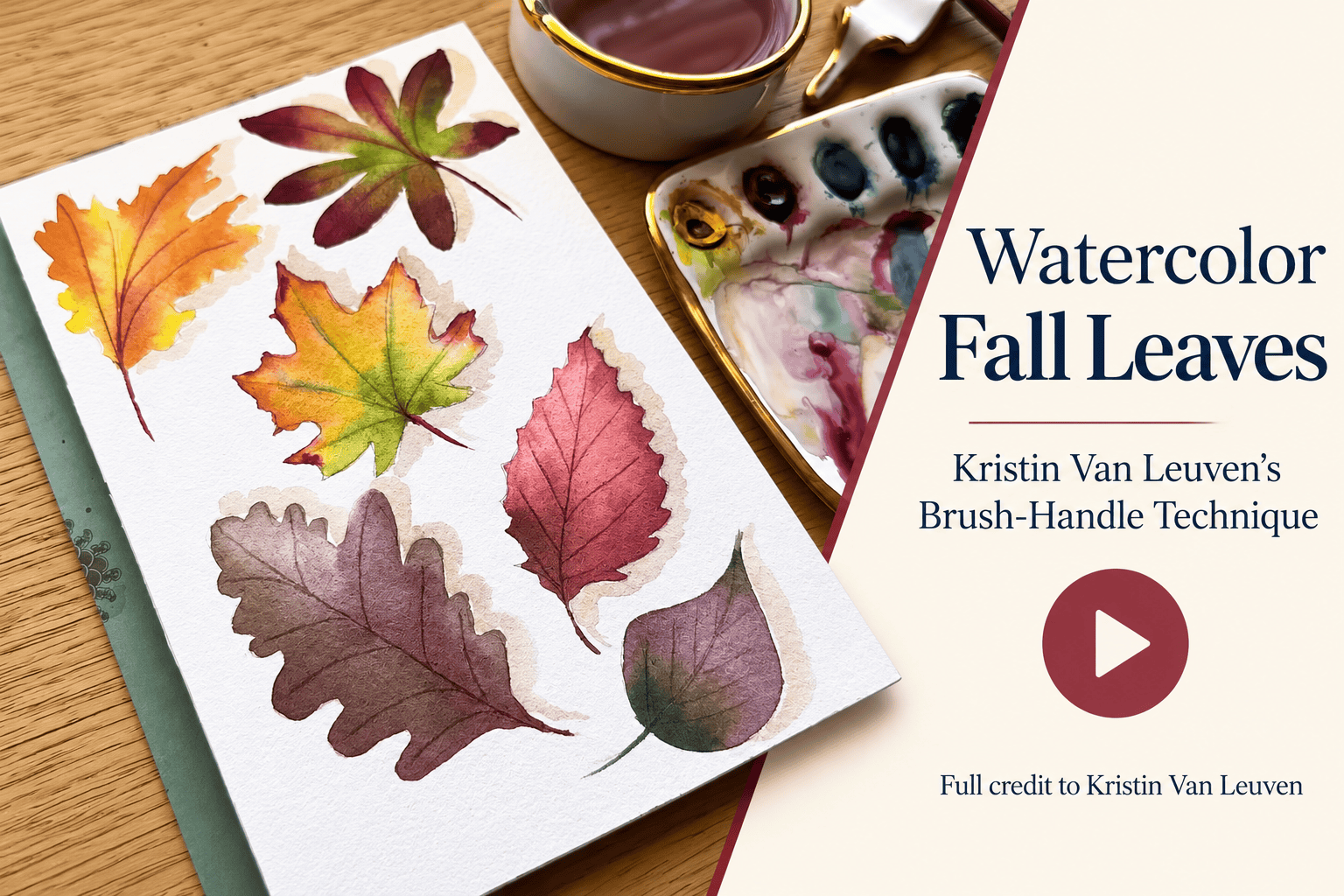
Kristin Van Leuven paints a collection of watercolor fall leaves with a limited palette and an unexpectedly useful part of the brush: its handle. While the washes are still wet, the artist presses the handle end into the paper and draws pigment along the resulting marks, creating fine stems and veins.
The demonstration combines this technique with lightly sketched shapes, changing autumn colors, and selective highlights, showing how the same approach produces different results across six leaves.
Materials
Van Leuven names a compact selection of painting and drawing supplies. The palette provides the starting colors; oranges, muted maroons, purples, and browns are mixed during the demonstration.
Watercolor Palette
- Cadmium Yellow
- Quinacridone Magenta
- Cerulean
- Indigo
- Sap Green
Paper and Tools
- Baohong cold press watercolor paper
- Round watercolor brushes
- Water
- A rag or paper towel for removing excess water from the brush
- An HB pencil
- An eraser for adjusting the sketches
- A palette for mixing colors
The artist does not require a particular round-brush size. The handle end of a brush is also used to make the fine impressions that guide pigment into the leaf veins.
Reference photographs help establish the shapes and color patterns. Van Leuven also suggests an actual leaf as a reference when one is available.
Leaf Sketches That Balance Structure and Freedom
Beginning with a Curved Center Line
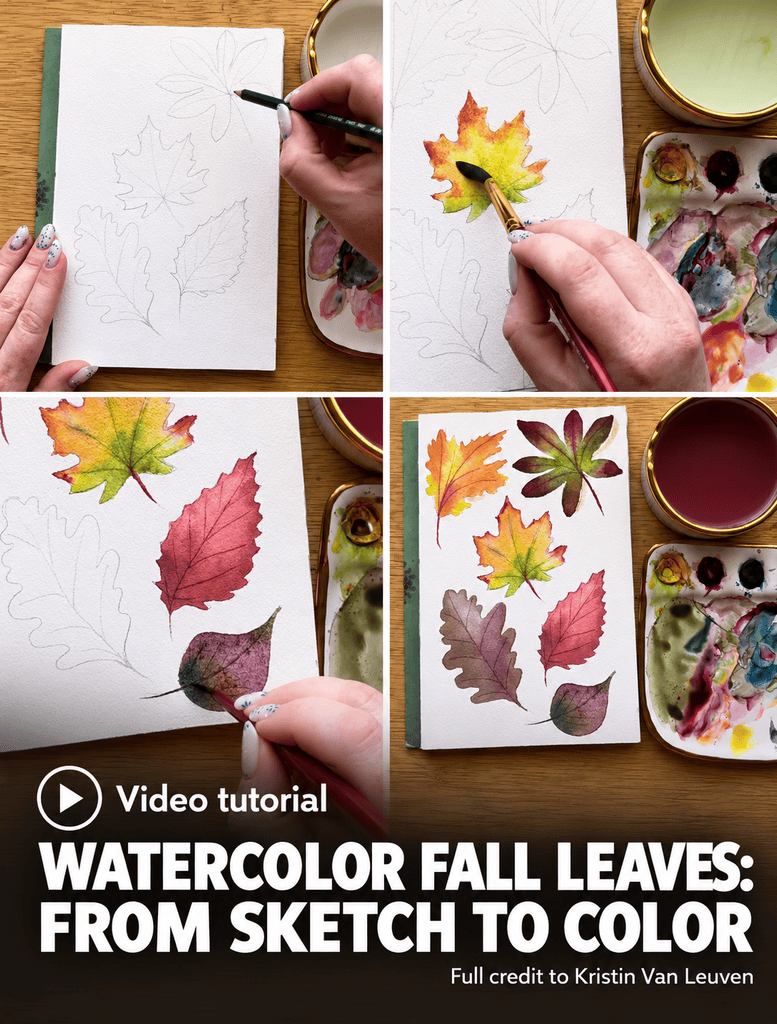
Although Van Leuven often paints loosely without preliminary drawing, these leaves benefit from a sketch. A guide helps prevent one side of a roughly symmetrical shape from becoming much larger than the other.
The center stem comes first in several drawings. Its curve establishes the direction, placement, and movement of the leaf before the outside edges are added. A curved center line gives the otherwise still subject a more animated shape.
For the more symmetrical forms, the artist works back and forth between the two sides, building corresponding sections a little at a time. The sides remain related without requiring every point or curve to match perfectly.
Adding Texture to a Simple Shape
A complicated outline becomes more manageable when it begins as a basic rounded form. Van Leuven sketches that larger shape lightly, then adds the uneven or jagged edge.
The references remain starting points rather than rigid patterns. Missing sections, irregular edges, or damaged areas can belong within the drawing. On one leaf, the artist enjoys the uneven rounded contours precisely because they allow a suggestion of symmetry without exact duplication.
The video also retains moments of erasing and redrawing. Some rounded sections prove difficult to sketch, and the artist explains that watercolor can later refine a curve that is not quite right.
Keeping the Pencil Light
The demonstration’s pencil lines are deliberately dark enough to show on camera. For the finished painting, Van Leuven favors a lighter sketch because the drawing remains visible beneath transparent watercolor.
Light marks also allow easier revisions to the outline, veins, and stem. The sketch supplies direction while leaving the painted shape room to develop.
A Limited Palette for Changing Autumn Colors
Van Leuven creates the autumn range through mixing rather than adding a separate tube for every color. Yellow and magenta produce orange, with a larger proportion of yellow in the mixture used for the first leaf’s tips.
A small addition of Sap Green to magenta produces a more muted, maroon-like mixture. This darker color becomes especially useful beside the lighter pink wash of another leaf.
The green and magenta combinations recur throughout the demonstration. Sometimes they blend into subdued autumn tones; elsewhere, more concentrated magenta remains distinct at the tips or stem.
The final brown leaf begins with a mixture of magenta, Cerulean, and yellow. When the mixture looks too purple, the artist adds yellow to neutralize it, then adds more yellow to shift the brown toward a warmer result.
The Brush-Handle Technique for Fine Veins
The central technique uses the end of a brush handle to make a slight impression in wet watercolor paper. As the handle moves across the surface, wet pigment travels into the groove, creating a narrow, darker mark.
Van Leuven introduces it after placing concentrated magenta at the stem of the first leaf. The brush is turned around, and the handle end draws that color into the leaf along the previously sketched lines.
The appeal is the quality of the resulting marks. The artist explains that painted fine lines can become thicker or less consistent than intended. The handle provides another way to create the slim, organic veins that suit the leaves.
Van Leuven also makes clear that this is an existing technique, not an invention being claimed in the video. Its value here comes from the different ways the artist applies it across the painting.
Wetness and Contrast Shape the Result
The paper needs to remain wet while the impressions are made. That moisture allows the pigment already on the surface to move into the marks.
Contrast also matters. A darker, concentrated passage supplies more visible color than a pale wash. The artist notes that the first example is relatively subtle, then demonstrates the effect more clearly on a leaf with a stronger dark mixture.
The direction of the mark determines which color is drawn through the leaf. Starting near a dark stem and moving outward gives a different result from beginning at a strongly colored tip and moving inward.
Six Leaves, Different Color Relationships
Yellow, Green, and Orange in the First Leaf
The first painted shape begins with clean water across the entire sketch. Yellow is dropped into the wet surface and concentrated through much of the center.
Sap Green enters near the lower part, stem, and vein areas. Orange is placed along the tips and edges, suggesting a leaf that still holds green while warmer colors develop around it.
A damp brush encourages the orange to blend into the yellow. Strong magenta at the stem then supplies color for the handle technique, linking the loose color transitions with more precise internal lines.
Pink with a Darker Muted Mixture
The next leaf begins with a light pinkish-red mixture of yellow and magenta. While that base remains wet, a little yellow restores brightness near the center.
Van Leuven then introduces the darker mixture made by adding a small amount of Sap Green to magenta. The contrast between the pale base and the muted dark color makes the impressed veins easier to see.
This example shows the mechanism clearly: pigment settles into the small depression made by the handle. The fine mark gains definition from the watercolor already present on the leaf.
Green with Magenta Tips
Another leaf begins with a relatively light green base. The earlier muted magenta mixture is added at the ends, followed by brighter, more concentrated magenta at the very tips.
When the colors need help moving together, Van Leuven rinses the brush and taps it against a rag or paper towel. The resulting damp brush moves the color without carrying the same amount of water as a fully wet brush.
For this leaf, the artist draws the handle from the strongly colored tips toward the stem. That direction pulls the bold magenta inward. Starting at the stem instead would draw more green into the impressions and create less of the contrast the artist wants in this example.
Classic Yellow, Orange, and Red
The upper-left leaf uses a more familiar autumn combination of yellows, oranges, and reds. Paint is added into wet paint so the colors can blend gradually.
Van Leuven points out that this working time changes with the surroundings. In a dry place, the paper loses moisture more quickly, reducing the easy blending available while the wash is wet.
A dark magenta stem supplies the vein color. Pulling it upward produces stronger darkness near the base and lighter, subtler marks toward the outer parts of the leaf.
The artist also notes that watercolor dries lighter than it appears during painting. The stronger wet accents are chosen with that change in mind.
Purple, Deep Green, and Indigo
The small teardrop-shaped leaf introduces a different color grouping. A mixed purple is combined with deep green and a little Indigo, creating a darker contrast within the simple outline.
Here the handle travels from the top through the leaf and continues beyond its base. That motion pulls color out of the painted shape to create the stem.
Additional veins are made before the wash dries. This variation extends the method beyond drawing internal lines: the existing wet color also supplies an external mark.
A Warm Brown Leaf with Lifted Highlights
The final leaf uses the warm brown mixed from the limited palette. Deep green and a darker magenta add variation until the contrast feels right to the artist.
Because the overall color becomes quite dark, Van Leuven returns with a rinsed, damp brush and removes paint from selected areas. These lighter passages restore some of the brightness admired in the pink leaf elsewhere on the page.
The lifting happens before the paint dries. The adjustment preserves variation within the brown rather than leaving the entire shape equally dark.
Finishing Shadows and Wider Uses for the Technique
At the end, Van Leuven adds a simple shadow because the leaves appear a little flat. The demonstration does not develop this into a detailed shadow lesson; it is a final adjustment to the collection.
The artist also describes possible uses for the handle technique beyond leaves, including small details on houses, tree trunks, branches, stems, and rocks. These are suggested applications for thin marks or texture, rather than additional subjects demonstrated in the video.
The closing advice is to use the technique sparingly and while the paper is still wet. Across the six leaves, its success depends on the relationship between moisture, the placement of darker color, and the direction of the handle.
The finished collection brings loose washes and fine details together. Light pencil guides establish the shapes, a small palette produces varied autumn colors, and pigment drawn into impressions creates veins that remain connected to each leaf’s existing paint.