

What makes a tulip field so calming and joyful at the same time? Kerrilyn Cheah believes it’s the blend of peaceful skies, rainbow colors, and simple, uplifting shapes that instantly brighten your mood.
In today’s tutorial, Kerrilyn Cheah paints a tulip field in watercolor—right in her sketchbook—and shares every step, from the first loose sketch to the final touch of white gouache.
If you want to paint along, grab your brushes and let’s get started.
Contents
- 1 Step 1: Planning and Sketching the Composition
- 2 Step 2: Painting the Sky and Clouds
- 3 Step 3: Painting the Tulip Fields
- 4 Step 4: Painting the Green Stems and Perspective Lines
- 5 Step 5: Adding Layers and Enhancing Texture
- 6 Step 6: Creating the Distant Background
- 7 Step 7: Painting the Windmill
- 8 Step 8: Adding Highlights and Finishing Touches
- 9 Wrapping Up
Step 1: Planning and Sketching the Composition
Before the painting begins, the artist plans out the scene with a simple pencil sketch. The paper is divided using the rule of thirds for this tulip field.
About two-thirds of the paper is reserved for the tulip farm and floral rows, while the top third is kept for the sky and a small windmill in the distance.
The horizon line is sketched first. If neat borders are preferred, tape can be placed along all four edges of the paper, but the artist likes to leave rough edges—just a personal choice.
The vanishing point is placed at one-third of the paper, and tulip rows are drawn that narrow as they move into the distance. This creates depth and keeps the layout simple yet effective.

Step 2: Painting the Sky and Clouds
The painting begins with the sky. Since the tulip fields will be filled with vibrant colors, the sky is kept light and simple to balance the composition.
A size 12 brush is used to lay down a light blue wash for the sky. Some white spaces are left—these will become the clouds.
Then, the paper is rewetted to create a soft, wet-on-wet effect for the cloud shapes.

Next, a light blue wash is applied. Tape can be placed on all four edges if working more comfortably with taped paper is preferred. This can help reduce paper warping, especially with heavy washes.

A soft tissue is used to dab and lift some paint gently. This creates soft, natural-looking clouds.
A few smaller clouds are added toward the bottom of the sky to give a sense of distance.

Some areas are darkened slightly for contrast. It is important to use soft tissue, not paper towels, to avoid harsh, dry edges.

And that finishes the sky.

Step 3: Painting the Tulip Fields
Now it is time to paint the tulips. Rainbow colors are used—yellow first, followed by orange.
This part of the painting is loose, so there is no need to focus too much on details. The goal is to have fun and play with vibrant, summery colors.

As the work progresses, darker orange is added to create depth and texture. These dry brush strokes give the painting more texture and movement.
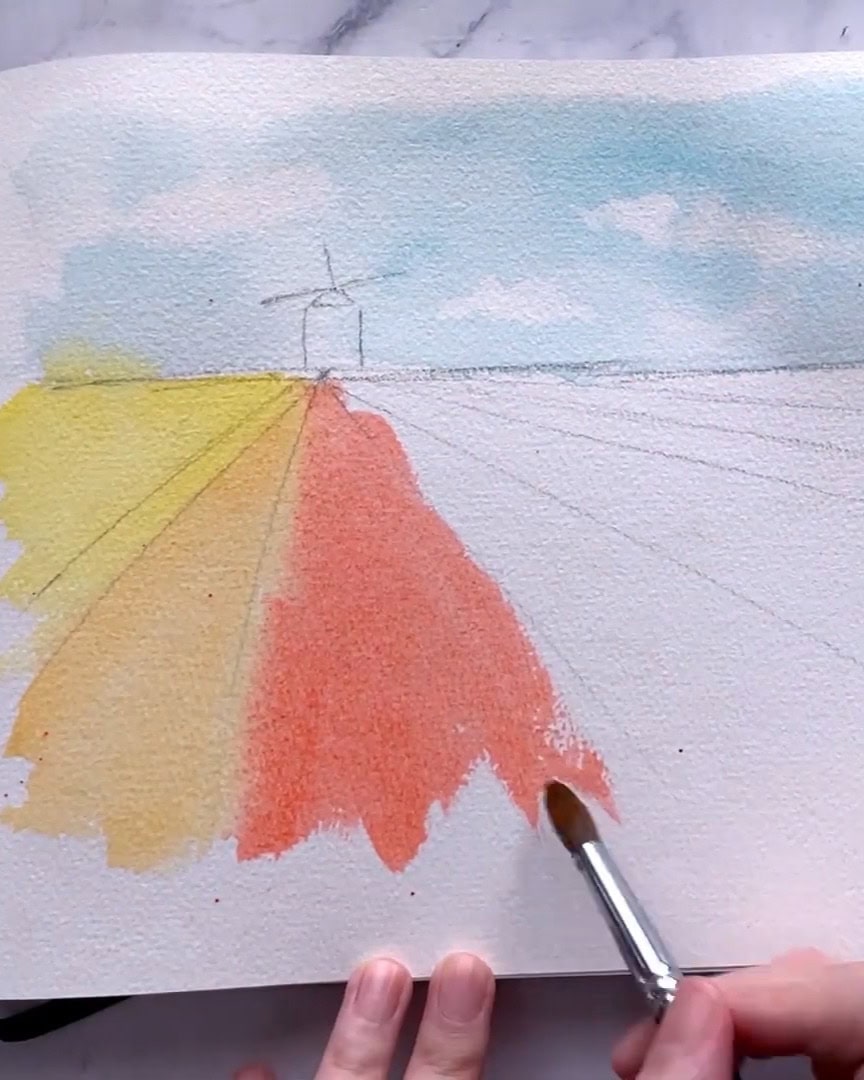
Next comes red, layered on top of the oranges for variety.

Color choices can be freely explored; there is no need to follow the exact palette. A touch of lavender and darker purple is added to bring more color to the composition. Colors are allowed to flow and blend.

Step 4: Painting the Green Stems and Perspective Lines
Next, a smaller size 6 brush is used to add greens. Sap green is mixed with greenish umber to create a rich, dark green.
The mixture is applied carefully, ensuring it is thick enough to avoid watery blooms. The paper begins to warp as more color is added—this is normal.

Step 5: Adding Layers and Enhancing Texture
As the process continues, more depth is added to the tulips by layering additional colors. Once the paper dries, the colors in the green stems appear lighter, sometimes even more than 30% lighter.
This is entirely normal, and vibrancy can be brought back by applying another layer of paint.
 Apply the second paint layer to the stems
Areas that need more pigment are darkened. Adding more color is essential, but if the paper holds vibrancy well after drying, this step can be skipped.
Areas needing more color are quickly covered.

While the paint is still wet, texture is added by splattering in water. This gives the painting a unique effect.

The same process is repeated for the other sections, reapplying layers where necessary to add richness.

To create more texture, a brushstroke technique is used. Brushstrokes are applied to the stems, especially in areas closer to the bottom of the page, becoming larger toward the bottom.

Next, a layer of water is applied over the tulip field. Using a size 8 brush, vertical strokes are laid down in the field, creating a more dynamic feel.
Vertical strokes and small dots are layered to add busyness to the florals. This breaks up flatness and gives the painting life.
These little details create the illusion of texture and depth, especially where the flowers are more defined.
If the paper is dry, areas are lightly rewetted before adding paint. This helps blend the colors smoothly, making the tulips stand out and the composition more realistic.
The further the tulips recede in the painting, the less defined they become.

Once the foreground is completed, more splatters may be added to give it an extra pop. With the added layers and texture, the tulips come to life.

Step 6: Creating the Distant Background
Next comes the distant background, which adds depth and perspective to the painting. The sky and trees in the background are painted.
First, the area near the horizon is rewetted to ensure a smooth and soft transition. The paper is lifted slightly to prevent the color from bleeding too much upwards.

Sap green is mixed with a bit of cobalt blue for the grass. This cooler mix helps create the illusion of distance, making the background feel far away.
By lifting the page, the artist controls how the green bleeds, ensuring it does not spread too far up the paper. This controlled technique gives the landscape a soft, distant feel.
Greens are then varied. Starting with the Sap Green base, cooler colors like blues or warmer colors like reds are added. This variation in greens helps create a more dynamic background.

As work moves closer to the horizon, the green is darkened by adding more pigment to the mixture. The darker green at the bottom of the paper helps bring depth to the scene, mimicking natural gradients in real landscapes.
This technique keeps the background soft while giving it a sense of space.

With the background set, this layer is quickly dried before moving on to the next step: painting the windmill.
Step 7: Painting the Windmill
Now that the paper is dry and flat again, the windmill is painted. For this, a bit of burnt umber and burnt sepia is mixed. The lighting is considered first.
With the sun coming from the left, the right side of the windmill is kept darker to create a shadow effect. A little yellow is added on the left side to make it warmer.

To deepen the shadows, sepia mixed with a touch of neutral tint is used.

With a fine-tip brush, the lines of the windmill are carefully drawn, using broken lines to give it character.
Warmer tones are applied on the side closer to the sun, using burnt sienna and yellow ochre instead of the darker sepia.

Once done, the windmill is quickly dried to prepare it for the final touches. This adds great depth to the piece, making the windmill stand out against the vibrant tulip fields.
Step 8: Adding Highlights and Finishing Touches
A white ink pen is used to bring back some of the highlights, especially in the darker areas of the painting.
If a white ink pen is not available, white gouache can be used instead—it works just as well. The ink pen here is chosen simply for convenience.
Next, attention moves to the grass areas. Small dots of white are added to brighten parts that look a bit flat. These little touches help lift the whole area.
Care is taken not to overdo it. Highlights are added where it is quite dark, like near the shadows. Color areas are skipped this time, because the white does not appear well there.

Once the highlights are in place, dry splatters are added. The paper is completely dry at this stage, so the splatters come out sharp and clear, unlike earlier when soft splatters were applied on wet paper. A bit of orange and a little more purple are mixed in to add variety.

Still, the painting can benefit from more brightness. White gouache is used to add more splatter, which instantly improves the overall effect. To finish off, more tiny white dots are manually added to enhance the glow.

And that completes the final painting. The scene feels peaceful, the rainbow tulips look vibrant, and those last white highlights unify the whole piece.

Wrapping Up
Painting tulip fields in watercolor can be simpler than it appears—and incredibly rewarding. With a few straightforward steps, a peaceful and colorful scene can be created in a sketchbook.
This process can be adapted in many ways, allowing imagination to bloom with every stroke.